20 November 2006

20th Nov - 8th Transgender Day of Remembrance

The Transgender Day of Remembrance was set aside to memorialize those who were killed due to anti-transgender hatred or prejudice. The event is held in November to honor Rita Hester, whose murder on November 28th, 1998 kicked off the “Remembering Our Dead” web project and a San Francisco candlelight vigil in 1999. Rita Hester’s murder — like most anti-transgender murder cases — has yet to be solved.

Although not every person represented during the Day of Remembrance self-identified as transgendered — that is, as a transsexual, crossdresser, or otherwise gender-variant — each was a victim of violence based on bias against transgendered people.

We live in times more sensitive than ever to hatred based violence, especially since the events of September 11th. Yet even now, the deaths of those based on anti-transgender hatred or prejudice are largely ignored. Over the last decade, more than one person per month has died due to transgender-based hate or prejudice, regardless of any other factors in their lives. This trend shows no sign of abating.

The Transgender Day of Remembrance serves several purposes. It raises public awareness of hate crimes against transgendered people, an action that current media doesn’t perform. Day of Remembrance publicly mourns and honors the lives of our brothers and sisters who might otherwise be forgotten. Through the vigil, we express love and respect for our people in the face of national indifference and hatred. Day of Remembrance reminds non-transgendered people that we are their sons, daughters, parents, friends and lovers. Day of Remembrance gives our allies a chance to step forward with us and stand in vigil, memorializing those of us who’ve died by anti-transgender violence.

Who

[No Photo]Rani
Location: Calcutta, India
Cause of death: Blunt force trauma
Date of death: November 20, 2005
Rani, a young hijra from north Calcutta, had been left to live separate from her family, and usually slept on the pavement. Her killers found her asleep, dropped a heavy stone on her head, and left her to die. She died from injuries from this blow.

[No Photo]Vanessa Facen
Location: San Diego, California, U.S.A.
Date of death: November 21, 2005
Cause of death: Stopped breathing during a melee with sheriff’s deputies
Facen, 35, was in the custody of San Diego police after being found naked and bleeding inside her neighbor’s home on November 17th. While it is unclear as to why Facen became violent while in police custody, signs indicate that it was her treatment by officers — who insisted on treating her as male while in custody — that contributed to her actions.

[No Photo]Unknown person wearing womens’ clothing
Location: Northridge, California, U.S.A.
Cause of death: Beat to death with a garden hoe by John Freeman
Date of death: November 27, 2005
The victim, 31, was at Freeman’s house when neighbors reported hearing a heated argument. She was allegedly attacked by John Freeman, who struck her with his fists, feet, and a hoe. Freeman had a casual relationship with the victim prior to the murder.

[No Photo]Simone Walton
Location: Oak Cliff, Texas, U.S.A.
Cause of death: Shot to death
Date of death: December 4, 2005
Walton, a forty year old, died shortly after midnight in the 3200 block of Linfield Road in east Oak Cliff.

[No Photo]Roberta Oliveira
Location: Milan, Italy
Cause of death: Stuck by a car
Date of death: December 8, 2005
Oliveira was a twenty eight year old Brazilian transgender woman living in Italy. She was deliberately struck by a vehicle.

[No Photo]Paulina (Juan Pablo MŽndez Cartagena)
Location: Guatemala City, Guatemala
Cause of death: Shot to death
Date of death: December 18, 2005
Paulina worked for Integral Sexuality AIDS Support Organisation (OASIS). She was in Guatemala city with a second transwoman when four men on motorbikes, wearing police uniforms, ordered them to stop — then shot both of them. Paulina was shot twice in the head, and died minutes later. Sulma, the other victim, survived three gunshot wounds.

[No Photo]Alexis (Brandon) L. King
Location: Nicetown, Pennsylvania, U.S.A.
Cause of death: Shot to death
Date of death: February 3, 2006
King, 21, was shot to death in the pre-dawn hours of February 2nd by Terron Oates who was found by police at the scene. Oates confessed to the murder.

[No Photo]Tiffany Berry
Location: Memphis, Tennessee, U.S.A.
Cause of death: Shot 3 times
Date of death: February 9, 2006
Twenty one year old Tiffany Berry, identified as a pre-operative transsexual, was shot and killed at the Camelot Manor Apartments in South Memphis. While investigators have said this was a robbery homicide, Berry’s purse was wound, intact, with her body. Police claim that Berry’s transgender status had nothing at all to do with the murder, while others outside of law enforcement disagree. Anyone with information in this case is asked to call Memphis Police Homicide at 545-5300.

[No Photo]Yardena Marsh
Location: Tel Aviv, Israel
Cause of death: Shot to death
Date of death: February 15, 2006
Yardena Marsh, the first known Israeli to have genital reassignment surgery, was found dead by her sister in Marsh’s Tel Aviv apartment. Her confessed killer, Ze’ev Bisso, initially claimed that his gun had accidently fired and struck marsh.

[No Photo]Gisberta Salce Junior
Location: Porto, Portugal
Cause of death: Beaten and stoned to death
Date of Death: February 22, 2006
Gisberta was a homeless transgender woman who had been living in a shelter for many months. Her death was a violent one, lasting for several days as she was repeatedly beaten, sodomized with sticks, burned, kicked, stabbed, and stoned by a group of up to fourteen teenagers. After she expired, they dumped her into a ditch.

[No Photo]Melissa “Mo” Green
Location: Phoenix, Arizona, U.S.A.
Cause of death: Shot to death
Date of death: March 21, 2006
Twenty-two year old Melissa Green was shot from behind, by a single bullet, in what seems like a planned killing. She bled to death from her injuries before paramedics arrived on scene. Anyone with information in this case is asked to call Phoenix police at (602) 262-6141, or Silent Witness at 1-800-343-TIPS. There is a $2,000 reward being offered for information leading to an arrest of indictment of the murderer.

[No Photo]Rupesh Mandal
Location: Mahotari district, Nepal
Cause of Death: Suffocated
Date of death: March 30, 2006
Rupesh was a thirteen year old transgender girl living in the Mahotari district of Nepal. Rupesh’s father, Tapeshore Mandal, had banished her after discovering that she was going to meetings of the Blue Diamond Society, the only organization in Nepal for sexual minorities. While she did rejoin the family after promising to stop going to the BDS, her father continued to abuse and neglect her, and said that he would kill her unless she stopped presenting herself as female. Her mother found her body. The father claimed that she had poisoned herself, but a most-mortem indicated that she died of suffocation, not poisoning.

[No Photo]Alfred Dibble
Location: Stockton, California, U.S.A.
Cause of death: Beaten to death
Date of death: May 20, 2006
Dibble was a 34 year old nurse. was severely beaten and left to die on the corner of Miner Avenue and Sierra Nevada Street in Stockton, California. Dibble died from injuries sustained in the beating while at a stockton hospital. Anyone with information in this case is asked to call either Detective Robert MacDonald or Detective Ed Rodriguez of the Stockton Police Department at (209) 937-8323

[No Photo]Sudha, aka Lakshmi
Location: Tiruchy, India
Cause of death: Throat slit; also multiple stab wounds to the genitals
Date of death: May 26, 2006
Sudha was a transgender sex worker in India. She was picked up at the Central Bus Stand on May 25, and her and a male, likely her murderer, checked in at a private lodge. She was found there, in a pool of blood, after her throat was slit, and after several cuts to the genitals. Police suspect that Pandian of Taranallur was her killer.

[No Photo]Barbara (Geovanny) Calderon
Location: Guatemala City, Guatemala
Cause of death: Drive-by shooting
Date of death: June 10, 2006
Calderon, a Honduran, was murdered in a drive-by shooting attack, part of a string of violent acts against sex-workers and transgender people in Guatemala. Two other transgender women, and one gay male, were injured in the attack.

[No Photo]Lupita (Juan Carlos Charria)
Location: Gardolo-Trento, Italy
Cause of death: Stabbed multiple times, allegedly by Engjell Ndreca
Date of death: July 29, 2006
Lupita, a twenty nine year old Colombian, was a sex worker in Italy. A client of her’s, Engjell Ndreca, is believed to have stabbed her five times. When captured by police, he nitially claimed Lupita was his “boyfriend” and that she was HIV-positive, but several contradictions have appeared within his story.

[No Photo]Lezlie Anne Field
Location: Bangkok, Thailand
Cause of death: Multiple gunshot wounds
Date of death: August 2, 2006
Field, a thirty one yer old transsexual American living and working in Thailand, was initially believed by police to have committed suicied in the apartment she shared with a Thai friend. The suicide note left with her appeared to be a forgery, and was not written by Field.

[No Photo]Mikey Vallejo-Seiber
Location: Riverside, California, U.S.A.
Cause of death: Internal injuries, allegedly by Alex Mendoza
Date of death: August 15, 2006
Vallejo-Seiber was a three year old who was repeatedly called a “sissy” by his father, Alex Mendoza. Mendoza also often slapped his son in an effort to “toughen him up,” and urged him to beat up on Vallejo-Seiber’s Elmo doll. Mikey Vallejo-Seiber died in a local hospital from internal injuries sustained from being kicked, punched, and dropped on his head. He was in Mendoza’s care at the time. His mother Pamela Seiber, pleaded guilty to child endangerment and was sentences to six years in prison.ÊMendoza has entered a plea of not guilty.

[No Photo]Edgar Cano Camacho
Location: Milan, Italy
Cause of death: Stabbed multiple times
Date of death: October 19, 2006
Camacho was a forty one year old Peruvian living in Italy. She died in her home after being repeatedly stabbed in the face.

10 November 2006

India eunuchs turn tax collectors

See the tax-collecting eunuchs


Tax authorities in one Indian state are attempting to persuade debtors to paying their bills - by serenading them with a delegation of singing eunuchs.

Eunuchs are feared and reviled in many parts of India, where some believe they have supernatural powers.

Often unable to gain regular employment, the eunuchs have become successful at persuading people to part with their cash.

The eunuchs will get a commission of 4% of any taxes collected.

In Bihar's capital, Patna, officials felt deploying the eunuchs was the only way to prompt people to pay up.

We are confident that their reputation and persuasive skills will come in handy
Bharat Sharma
Patna official

"We are collecting taxes for the municipal corporation, collecting money from those who have not paid their taxes for years," said Saira, one of the eunuchs on the streets of Patna.

"Tax payment is necessary. When the corporation won't have any money how will they look after the people?"

Accompanied by police officers, the eunuchs approached shopkeepers and large defaulters on their first foray into tax collection.

"Pay the tax, pay the Patna Municipal Corporation tax," the eunuchs sang as they approached Ram Sagar Singh, who owed 100,000 rupees (£1,180), the AFP news agency reported.

Mortified by the commotion, Mr Singh reportedly agreed to pay up within a week.

The eunuchs collected about 400,000 rupees on their first day of work, authorities said, sharing 16,000 rupees (£188) amongst themselves.

Bharat Sharma, a revenue officer, told the Associated Press agency he was pleased with the eunuchs' work.

"We are confident that their reputation and persuasive skills will come in handy," he said.

source BBC

06 November 2006

Pakistan's ground-breaking transvestite

By Syed Shoaib Hasan
BBC News, Karachi

Nawazish Ali has proved to be universally popular

"Darling, you are sooo naughty," purrs an elegant sari-clad woman glowing out of primetime television.

Going by the name of Begum (Lady) Nawazish Ali, she hosts an eponymous talk show that has taken Pakistan by storm.

Flirting and skirting her way through politics, society gossip and plain old sexual chemistry, Begum has become the most popular icon to inundate Pakistani fantasy in a while.

How is this possible in Pakistan where what is acceptable behaviour from female actors is still largely determined conservative Islamic values?

The answer lies in the identity of the Begum - who is a woman in every sense except the biological one.

"I am God's child," says a smiling Begum Nawazish Ali, or Ali Saleem to give him his birth name, talking to the BBC in his "normal guise".

Clad in jeans and T-shirt, 27-year-old Ali talked passionately about his life and work.

"As long as I can remember, I have wanted to be a woman," he declares.

Nawazish Ali
I never refuse anyone anything
Nawazish Ali

Twirling his shoulder length curly brown hair, Ali looks wistfully in the distance as he recounts how it was growing up in Pakistan for someone so unconventional.

"My father was in the army and we used to move around quite a bit," he says.

With his parents, he accepts there were problems, leading to his examination by a psychologist when he was 14-years-old.

The psychologist, however, allayed all fears, and "from that time on my parents were totally behind me".

That Ali was different from other boys was quite evident from his interests.

"I loved playing with dolls and dressing up with my female cousins to whom I have always been very close," he recounts.

In those days of innocence, he would often dream of becoming a woman.

"I wanted to be Sri Devi, Nazia Hasan, Benazir Bhutto... all the beautiful and powerful women in my world," explains Ali.

'Worst period'

Gifted with a great voice and a natural sense of the theatrical, he delighted in displaying his talents.

That was in the early 1990s in Islamabad. Soon after, in 1995, Ali shifted with his family to Karachi.

Nawazish Ali
Nawazish Ali is one of Pakistan's few openly transvestite people

This was "the worst period in my life", he confesses, with his parents going through a divorce.

It was during these depressing days that Ali met "Yasmin, who made everything possible".

Yasmin Ismail was one of Pakistani television's finest actresses, who died of cancer last year.

"She was the best thing that ever happened to me," says the screen star.

Ali explains how Ismail introduced him to theatre, groomed his natural histrionics and generally played the part of his mentor.

"She was my mother, father and best friend," says Ali wistfully, adding "I give her 100% credit for any success I have achieved."

Ismail was involved in a popular theatre group called Gripps, and that was where Ali started out.

"My first performance was in a play called 'Art ya Atta' (Art or Bread) in May 1998," Ali says. He did an impersonation of former Prime Minister Benazir Bhutto in the play.

"When I spoke, there was pin drop silence and then the house came down," he exclaims.

The applause was thunderous and the show did record business.

Divorced socialite

The next six years were those of learning and growth. During these times, Ali expanded his repertoire with considerable success.

Nawazish Ali
The actor loves being the darling of the audience

In March 2004, the idea for transvestite chat show hostess Begum Nawazish Ali first came up during a discussion with friends Nadeem Baig and Omar Adil, a national TV host, in Lahore.

"Omar said that he saw me as much more than the typical characters I was doing and we came up with the idea of this middle aged divorced socialite who knows everybody," gushes out Ali.

Initially, Ali promoted it with GEO, one of the largest TV channels. That deal failed to materialize and rival channel Aaj took up the challenge, quickly putting out a pilot.

"Nadeem was Director entertainment and he told me to bring it over," Ali explains. Aaj moved quickly, and a pilot was soon out.

"It was like nothing anybody had seen," says Azfar Ali, a local television producer. "The most amazing thing was the fact that he was able to deliver it all in a way that the masses could relate to it."

Trivialising politics?

No sooner had the first programme finished than the show was the talk of the town.

From politicians to movie stars to sportsmen, all have had their turn on the show.

So popular has the show become that a sitting federal minister specially requested to be invited.

That may have been unnecessary, as Ali smiles and declares saucily, "I never refuse anyone anything".

The show is not without critics, who accuse it of trivialising politics in a country that has had more than its fill of dictators.

Ali denies this, saying "our politicians have been destroyed under a well thought campaign", adding "I want them to be popular again".

Furthermore, he says that the military - such a powerful influence in Pakistan - have been deliberately kept out of the show.

"I believe that democracy is the only option for us, and this is my contribution to the cause," Ali says determinedly.

He also wants to show what kind of country Pakistan really is, in contrast to the 'Terrorism Central' nation that it is often portrayed as.

"And I will do it," Begum exclaims and, smiling seductively, adds "after all who can resist me?"

03 October 2006

Dance Like A Woman 2

At 'Bin Baykancha Tamasha', men are the fairer sex, reports Mini Chandran-Kurian

In the garish yellow light of the naked bulb, their painted faces look larger than life. They are the 'nachya poras' of Bin Baykancha Tamasha — an eclectic version of the traditional tamasha featuring male dancers in female form.

"Aho suna raaya, sanga mee kashi diste?" asks the lead dancer coquettishly, and the audience collectively sighs, to break into loud clapping.

Says Anil Vasudevan, who conceptualised and choreographed Bin Baykancha Tamasha, "This performing art elicits unexpectedly uninhibited responses from the audience, particularly to male dancers."

Vasudevan, a dancer, who put in over 30 years at Mafatlals at a desk job, and then gave it up to adopt choreography as a full-time profession; does make-up for Bharat Natyam artistes, besides choreographing classical and folk performances. In the last two years Bin Baykancha Tamasha has given over 250 performances, and an elated Vasudevan says his boys have enthralled disparate audiences including housewives, politicians, businessmen and corporate executives.

Tickets are priced between Rs 50 and 100, and therefore the dancers are still paid only Rs 200 to 500 per show. The singers are a huge draw, especially Vinay Koli and Jayesh Kale who sing in both male and female voices. Koli who works in Syndicate Bank by the day, says that it is a gift from God. "I cannot act like a woman or dance like a woman, but I can sing better than one!" So is he constantly requested by neighbours and others to sing in both voices? "No, I can't do that," he says candidly. "It's only when I am on the stage that I open my mouth and the voice just pours out…"

Do the dancers ever face an identity crisis? Nitesh Jadhav who is hailed as the most exquisite 'woman' in the show replies in the negative. "It doesn't affect me. Once I wear my sari, I become a woman.” Rajesh Sukant Bodke who is a lecturer at Bodke Classes, and Anil who runs a telephone booth, feel that they would be unable to find this kind of admiration in any other profession, and that the little discomforts do not count in the larger picture.

However, Vasudevan admits, "Some men in the audience do laugh at them, but the women simply love them! They are great performers and ultimately that's all that matters."

The seduction is complete, right from the moment the mujra begins, with the dancers making a dramatic entry, their backs to the audience; and then flinging off their pallus and turning around to face the audience… The Gavlan song follows and then the tongue-in cheek Karbhari Damana, the boisterous Kheltana Rang Bai Holicha and the ever popular Ya Ravji, Basa Ravji…

Clearly, here are Mumbakars eager to take in a spot of culture, not out of the ordinary for a city that thrives on the unusual and the unexpected.

Source: Mumbai Mirror - (contributed by Jaya)

Watch a Video of a NDTV report on the same subject: Men no Bar


19 July 2006

"I tried to kill myself..."Bobby Darling about living a life full of humiliation

Saturday, July 08, 2006
On her childhood
My real name Pankaj Sharma. My father (Bobby is not comfortable
naming her family members) was an English professor and a bank employee. My elder sister is a perfect housewife, while my younger brother is a fashion designer. Even as a child, I was an introvert and would only play with girls. The first time I dressed up like a girl was when I was in the eighth standard. I would often apply lipstick and wear saris from my mother's closet. By the time I reached class 12, I had a serious relationship with a classmate. My parents were alarmed and took me to various specialists including a sexologist and a psychiatrist. My father used to beat me for my sexual preference too. But I don't blame my parents for it. They weren't to blame.

Moving to Mumbai

I was aware that if I did anything to affect my father's social status, he would kill me. To avoid such a situation, I eloped with my boyfriend just before my exams. We travelled like a happy couple all across the Asia and Europe. It was very exciting. After two years, I got a call from my dad, saying that mom was unwell and she wanted to see me. I was by her bedside when she died due to kidney failure. Just four days after her demise, my boyfriend called our relationship off saying that he had to fulfil his responsibilities towards his parents. He got married, and now he has kids too. I headed straight to the bathroom and emptied a bottle of phenyl down my throat. My father saved my life. Constantly teased by friends in college, I left Delhi, with Rs 8,000 in my pocket. I decided to move to Mumbai.

Life in dance bars
As the train entered Bombay Central, I began to feel scared. I had heard odd stories about Mumbai. I knew no one in the city. For 15 days, I lived in railway stations, sleeping on the platforms. People would often taunt me and call me names like 'chakka', 'hijra', 'chikna'. It made me cringe. Later, I managed to find a roof over my head and moved to Malad, where I stayed in a house with four girls who used to work in a bar. They informed me that a gay dancer in their bar was earning enough money to sustain himself. Luckily I found employment there. My features are like a girl's, so very often customers would get confused and make indecent proposals to me. But soon, I began to feel stifled and started to look for roles in TV serials. I would walk down from one office to another the whole day. At 5 p.m I'd go to work at the bar. I never went to bed before 1.30 a.m in those days.

Becoming Bobby Darling
The initial days were very humiliating for me. I still remember how Makrand Deshpande had laughed at me. I realised that in order to find work I would have to re-invent myself. Is dhande mein dikhoge nahin to bikoge kaise (if you don't look good, how will you sell?) I was ill-treated by many filmmakers. They would call me gur (meaning jaggery, a slang used by Mumbaikars for gays). Bobby was my pet name. Director Lawrence D'Souza suggested that I add 'Jaan' after my name. Other names recommended were Bobby Chikna, Bobby Sexy, Bobby Hot. Once, when I went for an audition at N Chandra's office, he asked me my name. I said, "My name is Bobby Darling". His eyes lighted up immediately. He liked my name and promised to give me work.

Her Colleagues
My first film was Subhash Ghai's Taal, in which I played the role of Aishwarya's make-up artist.They shot for 19 days with me, but when the film released I was barely there. I felt bad, but what could be done about it? Later, I worked with Hrithik Roshan in Na Tum Jano Na Hum. He was very sweet to me and always greeted me with a hug. Recently, I met him at a party, and he doesn't seem to have changed at all. Even Salman Khan is very fond of me. I am also grateful to Moon Moon Sen and her daughters for all their help.

Sexual Preference
I am in the process of undergoing a sex change. I am taking hormonal injections which will develop my breasts. I am counting on laser surgery to remove my body hair. I am not yet sure where I'll get the surgery done. In India, it will cost me Rs 4 lakh, but in USA the cost will be about Rs 10 lakh. I would prefer the US, as such surgery is done there on a regular basis.

Life after films
Things are looking better for me. Now, my father talks to me. I am getting better roles. I have my own apartment in Oshiwara, and I have recently bought a car. I feel secure. Now, I am focusing on my sex change. I want to live like a woman. Plans after sex change After my operation, I will not return to India. I will quit Bollywood, because I am sure that people will make a mockery out of me. They will say, 'Pehele gay tha, ab heroine ho gaya hai! (Earlier he was gay, now he is an actress)'. I don't want to get humiliated after spending so much money. Perhaps I will become a pole dancer. I know I will have to start from scratch, but then I have never been afraid of challenges. . The initial days were very humiliating for me. I still remember how Makrand Deshpande had laughed at me. I realised that in order to find work I would have to re-invent myself. I was ill-treated by many filmmakers. They would call me 'gur' -
Bobby

source:
Mumbai Mirror, India interview by Ram Kamal Mukherjee

12 July 2006

In Mourning for Mumbaikars

Yesterday as six million mumbaikars (Bombayites) took the suburban trains to return home, seven bombs killed over 200 people, and injured and maimed hundreds more. Simple people returning to their loved ones and families after a hard days work.

I condemn these terror tactics used by whoever it maybe and whatever cause.
I pray for peace and that one day human beings can live without harming others!

05 July 2006

I Used to be a Boy

Check this video of this beautiful Tg woman from the US:

03 July 2006

There’s a spring in this eunuch’s step

Source: DNA-Mumbai
V Narayan
Thursday, June 29, 2006 21:46 IST

Pic: Lakshmi Narayan Tripathi at the Dai Welfare Society office in Govandi

Laxmi Narayan Tripathi, a eunuch from Thane, has hung her dancing shoes. Only to spend her time and energy in serving her community as president of the Dai Welfare Society in Govandi.

A professional Bharatnatyam dancer, Laxmi started learning the dance form when she was 12 years old.

“It was a hobby which I started in class VII. Initially, four students joined my dance class in Thane (West),” she said. Today, over 300 students have been enrolled in nine Bharatanatyam and contemporary dance schools, started by Laxmi, named Lucky Chance Dance Academy.

While doing a commerce diploma, she choreographed dance events and became a model coordinator. She went on to do a postgraduation in Bharatnatyam from the University of Mumbai in 1996.

“After that many students joined my dance class,” she said. Apart from dance classes, she did stage shows, took part in Bollywood flicks and later worked at Topaz Bar in Bandra (East).

On her journey to self-discovery, Laxmi worked for five years at the Duru dance bar in Ulhasnagar.

“I wanted to be a courtesan. It’s such a respectable job,” she said, with a laugh.

Atharva Nair, Laxmi’s friend and assistant at Dai, laughs loudly at this. “Tell her the truth,” he said. “You wanted to lure men!” Laxmi is unabashed. “He’s a bad boy, but it’s true.”

Another eunuch said, seeking anonymity, said, “Today Laxmi focuses her full time towards social activities. Even today, she is fit to dance like before.”

For a cause: Founded in 1999, 'Dai Welfare Society' in Govandi—an NGO formed for the support of eunuchs—now has 4,000 members in Mumbai and Thane.

It instructs lakhs of eunuchs on how to deal with AIDS. It holds 6-7 AIDS awareness
programmes at railway stations, BMC hospitals, gardens and bus stops every month.

29 June 2006

NEWS 29 June 2006

Dear Readers,
Thank you for visiting my blog. I am happy that so many people have visited my blog (over 5500 hits since Dec 2005).
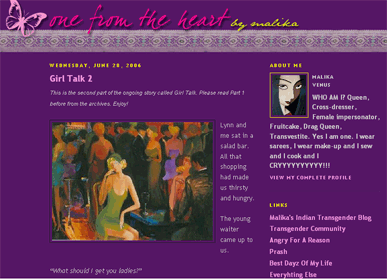
I have opened a new blog which is called 'One from the heart' which will be more of a personal blog, with features like Girl Talk! (Part 2 is posted), and my own articles will be published. Thus Malika's Transgender Blog will be a more of a news and information blog .
Please leave your comments as they give me a possibility to understand what you like or dislike about my posts.
Enjoy!

malika
miss_malika(at)yahoo.com

28 June 2006

Transgender MP fights toilet 'apartheid'

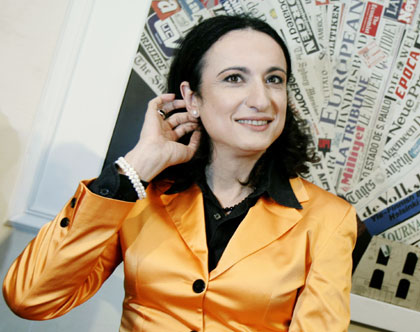
Italian transgender MP Vladimir Luxuria gestures during a news conference at the Foreign Press Association in Rome in this February 22, 2006 before her election.

ROME - Among the most pressing orders of business for Europe's first "transgender" lawmaker may be fighting over which toilet to use in the Italian parliament.

Italian transgender election candidate Vladimir Luxuria gestures during a news conference at the Foreign Press Association in Rome February 22, 2006. The 40-year-old from Italy's main communist party is a candidate in the country's general election in April.


Elected last month, Vladimir Luxuria said on Thursday she was opposed to toilet "apartheid" after a centre-right lawmaker suggested the creation of a special, third lavatory for all transgender politicians.

In Italy, and all of Europe, that means just Luxuria.

"I didn't expect politics to sink this low," Luxuria, a 40-year-old drag queen and defender of gay rights said in an interview with the online edition of Corriere della Sera daily.

Born Wladimiro Guadagno, Luxuria prefers to be referred to as a she and expressed a general preference for women's bathrooms. She suggested women reacted better than men did.

"There are many difficult moments in the life of a transgender and even some embarrassing ones, like the use of public bathrooms. Maybe we go to the ladies' toilet because the men get embarrassed," Luxuria said.

Italy's first transgender lawmaker Vladimir Luxuria, who entered parliament under the Communist Refoundation party's banner, waits for the results of the vote for Italian lower house speaker Fausto Bertinotti at the Montecitorio Palace in Rome April 29, 2006.

The transgender toilet, Corriere said, was suggested by a newly elected lawmaker in the lower house of parliament, Lucio Barani, a member of centre-right opposition.

Barani said in a statement it would avoid embarrassment.

Luxuria, who has dressed in low-key women's suits since entering the world of politics, is keen not to be considered a novelty along the lines of porn star Ilona 'Cicciolina' Staller who sat in the assembly in the 1980s and was famous for her impromptu stripteases.

Among her campaign issues was a promise to seek legal recognition of civil unions by homosexual couples.

"The apartheid of urinary segregation is not an issue that moves me particularly," Luxuria said. "I don't want the privilege of having a toilet all to myself."

It is not the first time that Luxuria has found herself under attack by the centre right.

Alessandra Mussolini, granddaughter of Italy's wartime fascist dictator Benito Mussolini, attacked her on state television when she was asked by Luxuria whether she wanted to lock up homosexuals.

"Meglio Fascista che frocio ! " Better a fascist than a faggot," Mussolini snapped.

See the Video clip of the above discussion in Italian:
duration: 1:06

20 June 2006

Begum Nawazish Ali - Pakistani Transvestite Tv Hostess


Ali Salim's Alter Ego
Dressed to shock, the Begum has it her way
Begum (Mrs.) Nawazish AliBorn a boy, Ali Salim long prayed to God to make him a girl. Years later, he is the most famous female TV identity in this devoutly Muslim, male-dominated country, even though his physiology remains unchanged.

Salim’s chiffon-wearing alter ego, Begum (Mrs.) Nawazish Ali, has become an overnight star, using style and pomp to confront prickly topics with Pakistani politicians, Islamic religious figures and celebrities, posing questions that more established journalists routinely steer clear of.

He is very reminiscent of Dame Edna, Australian Barry Humphries’ famous alter ego for the stage and TV, but Salim says that his character was not inspired by the more slapstick Australian. “I have heard about Dame Edna and have also gone to his (Humphries’) Web site, but I am not motivated by his show,” he said. “I do it in my style and he does it in his.” However like Dame Edna, Salim’s teasing and sarcasm has allowed him to tackle head-on the discrimination women face in Pakistan’s male-dominated society. “My show is about empowering women psychologically,” Salim told the Associated Press on the set of his popular show filmed in Karachi. “I am trying to show people that there is no difference between men and women. I have no gender bias. Men and women are equally capable of doing all the same things, except for their reproductive roles.”

Since it first aired eight months ago, ‘The Begum Nawazish Ali Show’ has built up a massive following, particularly among younger Pakistanis such as college graduate Saima Kareem, 23, who says that Salim “Is asking hard questions of people who otherwise remain untouched by TV shows.”

Begum (Mrs.) Nawazish AliWhile very popular, Salim’s show has ruffled some feathers in a country where Islamic customs generally frown upon cross-dressing. “We decided to create a larger-than-life character to host a talk show where the host would be flirtatious and look good allowing her a strong footing with her guests,” Salim explained. “She can intimidate her guests and break through their tough exteriors to reach the inner person that he or she is.” On the set of a recent show, film producer Rashid Khawaja pondered whether his host could be cast as a heroine for a future movie. Deeply immersed in his character as Mrs Nawazish, Salim curled his lip and suggestively replied: “Well, I don’t want a small one, I want a BIG one,” before clarifying the remark with, “I don’t mean that kind of role, I mean a role in the film.” Naimatullah Khan, a former Karachi mayor and Islamic political leader said that he did not even know Salim was a man when he went on the show. “Although I had the chance to say what I had in mind, I do have reservations on the way he conducts himself and talks,” Khan said. “I don’t think it is good to perform like this. It is not acceptable in our society.”

Dressed in character (a sleeveless, low-necked, blood-red chiffon gown) for an interview with The Associated Press, Salim said that he grew up surrounded by women; his divorced mother and her friends. “Ever since I was a child I used to fantasize about growing as a woman,” he said. His role models included former prime ministers such as Pakistan’s Benazir Bhutto, Margaret Thatcher of Britain, “and all other famous women of that time”.

Begum (Mrs.) Nawazish AliSalim said that his character helped put a modern face on a nation of 150 million people, which usually captures global attention through coups, earthquakes and war. “Begum Nawazish Ali represents the aspiration of all the Pakistanis who want a modern, progressive Pakistan,” Salim said. “She is the face of an enlightened, moderate Pakistan.” Salim said he plans one day to marry but only once he finds a partner of equal intellectual capacity. “I am a man performing as a woman,” he explained. “I don’t have a boyfriend or a girlfriend either.” Khalid Farshori, a senior media commentator in the weekly magazine Akhbar-e-Jahan, said that Salim’s show was groundbreaking and that it would encourage other channels to “come out with brilliant ideas to amuse viewers, who were fed up with the monotonous shows that we have here.”

Salim said he gets nothing but praise from his viewers, even after they realize he’s not really a woman. “Not a single piece hate mail or a threatening call,” he said. “Now people greet me on streets and show me love and respect.”

See an Episode (in Hindi) 30 mins in all

Part 1

Part 2

Part 3

12 June 2006

Transwoman Behind the Matrix Movies

"Matrix" and "Matrix Reloaded"
Director Larry "Lana" Wachowski
Following all the stories about ''Matrix'' co-creator Larry Wachowski allegedly taking hormones to prep for an upcoming sex change operation come reports from sources that say distributor Warner Bros. may be doing an alteration that will take a lot less work. For the third ''Matrix'' film , it seems the writing and directing credits for Chicago native Larry and his brother and partner, Andy Wachowski, will merely be listed as ''The Wachowskis.''

''That certainly would solve any gender issues that might be pending,'' a "Matrix" insider said Monday.

An in-depth story in the current National Enquirer goes into all the gory details of Wachowski's split from his wife, Thea, the onset of an S&M relationship with a dominatrix (who reportedly calls him ''Lana''), his penchant for wearing women's clothes and lingerie and his recent appearance at the Cannes Film Festival--wearing earrings, full makeup, etc.

Neither Warner Bros. nor a rep for the Wachowskis would comment on any aspect of this story.

pic: Lana with a journalist and Lana with brother Andy at the Matrix DVD release.

06 June 2006

India's eunuchs seek new way

By Sanghamitra Chakraborty in Tamil Nadu

Sudha is dusky and wears a salwar kameez, a traditional dress for women in India, but no make-up.

She is a eunuch (or "aruvani" as they now prefer to be called) and represents a group of transsexuals seeking respect for their identity and greater acceptance in society.

"While transgender people must protect their identity, we are willing to do our bit to gain acceptance," says Sudha on the sidelines of a community festival in southern Tamil Nadu state.

"If necessary we will dress down, tone down our speech, even desist from the commonly misunderstood practice of 'clapping' and negotiate with people in work and social settings."

Since most hijras end up being stereotyped as cross-dressing men, feared for their lewdness and aggression, the aruvanis face many day-to-day challenges, linked with their identity.

New tactics

For most hijras, as Indian transsexuals are called, their physical appearance is an extension of their transgender identity.

Lavish doses of make-up, flowing wigs, harsh, staccato clapping and aggressively sexual speech and body language are tokens of belonging, entrenched at an early age by community leaders.

Sudha(right) and Aruna(left in the picture) her friends want hijras to change tactics to win acceptance.

Eunuch groups now participate in community-led inter-personal communication sessions regularly in what they see as a pragmatic way to learn how to negotiate with the mainstream.

"We are focusing on the aruvani being a woman in day-to-day life, not just in front of the mirror at home," says Sudha.

Bharathi Kannamma, a journalist, says the communication sessions seem to be addressing the problem.

"Earlier, when aruvanis were teased or harassed, they fought back often by shouting and using foul abuse. This created a bad impression in the minds of the general community," she says.

Spreading awareness

A trainer, Rajakumari, says eunuchs are much more in control of their lives after attending the sessions.


We aruvanis have achieved in the past two years what was left undone in the past 20 years. Wait and see what young aruvanis can do
Aruna, transsexual

"When people mock or tease them, they don't take off in a rage as they understand that the public can be ignorant or insensitive," she says.

There is more on the minds of the aruvanis than celebrating their yearly festival in the village of Koovagam in Tamil Nadu.

"We're fighting for our right to live and work with dignity as other women do. The violence against transgender people must stop," says Sudha's friend Aruna, who marched along with 500 other transgender protesters.

"They lead many self-help groups working in Tamil Nadu, spreading awareness about safe sex and HIV to hundreds of transsexuals, many of whom are sex workers or beggars."

Delhi-based historian activist Mario D' Penha says there is a "huge debate" raging in the eunuch community "about the right path to integration and whether they should be seen as eunuchs or women".

Not recognised as females by law, these castrated males face a very real identity crisis. Once their surgery has taken place they are no longer considered male and there is no legal framework in place to deal with them.

One of the most important aspects of the training is to impress upon the community the need for safe sex.

Since many of them are extremely vulnerable to HIV, given their social isolation and low literacy levels, short films, documentaries and modern parables are used to improve social skills and to highlight health issues, such as the need to use condoms.

"From living on the fringes of society, they are not only working towards 'mainstreaming' themselves, but are now focusing on expression of their hidden talents that can contribute to them being accepted as citizens in their own rights," says Dr R Lakshmi Bai, chief of a local HIV prevention project.

Aruna is hopeful about the future.

"This is the way to go. We aruvanis have achieved in the past two years what was left undone in the past 20 years. Wait and see what young aruvanis can do."

Story from BBC NEWS:


Published: 2006/06/05 14:54:00 GMT

30 May 2006

Koovagam Festival - Transgender Festival

Get married in the night and break the 'thali' the next morning. This is the essence of the Koothandavar festival
celebrated by the eunuchs.

pic:
'Miss Koovagam' beauty contest Winner - Ranjitha (center) 1'st runner up - Mudumitha 2nd runner up - Rosie.

The village of Koovagam is next to Ulundurpet taluk in Villupuram district. The Koothandavar temple is situated in this village. This is the only temple for eunuchs, and their family deity is the Koothandavar.

A fifteen day Chitrai festival based on Mahabaratha is celebrated every year in grand style. According to the Mahabaratha, Rajakumaran, a eunuch was born to Arjuna and Naga Kannigai. The Pandavas, decided to sacrifice a human to ensure victory in the war and Rajakumaran was the sacrificial 'goat'. His last wish was to get married.

No one came forward to marry Rajakumaran. Lord Krishna appeared as a female and married him. The next day he was killed. To signify this, the marriage is held the previous night and breaking of the 'thali' the next morning is done every year as a ritual.

Check the link below for a interesting photo blog on Coovagam by RYAN LOBO

05 May 2006

Transsexuality in Iran

Before the Islamic Revolution in 1979, the issue of transsexuality in Iran had never been officially addressed by the government. Beginning in the mid-1980s, however, transgendered individuals have been officially recognized by the government and allowed to undergo gender reassignment surgery.

pic: Athena, a 20-year-old male to female transsexual in conservative Iran, brings tea to her father and her sister at her home in Tehran.


History

Pre-1979

In 1963, Ayatollah Ruhollah Khomeini wrote a book in which he stated that there is no religious restriction on corrective surgery. However, this applied only to intersexuals, and at the time Khomeini was a radical, anti-Shah revolutionary and his fatwas did not carry any weight with the Imperial government, which did not have any specific policies regarding transgendered individuals.[1]

After the Revolution

The new religious government that came to be established after the 1979 Revolution classed transsexuals and transvestites with gays and lesbians, who were condemned by Islam and faced the punishment of lashing and death under Iran's penal code.

One early campaigner for transsexual rights is Maryam Hatoon Molkara, who was formerly a man known as Fereydoon. Before the revolution, she had longed to become a woman but could not afford surgery. Furthermore, she wanted religious authorization. Since 1975, she had been writing letters to Ayatollah Khomeini, who was to become the leader of the revolution and was in exile. After the revolution, she was fired, forcedly injected with male hormone, and institutionalized. She was later released with help from her connection, and she kept lobbying many other leaders. Later she went to see Khomeini, who had returned to Iran. At first she was stopped and beaten by his guards, but eventually Khomeini gave her a letter to authorize her gender reassignment operation. The letter is later known as the fatwa that authorizes such operations in Iran.[2]

A small number of Iranian clerics have advised that homosexual men and women undergo gender reassignment in order for them to be able to live normal lives.

Contemporary status

Khomeini's original fatwa has since been reconfirmed by the current Supreme Leader of Iran, Ayatollah Ali Khamenei, and is also supported by many other Iranian clerics. [3]

pic: Maryam Hatoon Molkara, who was formerly a man known as Fereydoon, was an early campaigner for the rights of transsexuals in Iran.


However, there is still a great deal of stigma attached to the idea of transsexuality and gender reassignment in ordinary Iranian society, and most transsexuals, after completing their transition, are advised to maintain discretion about their past. Once a transgendered individual has undergone gender reassignment, that person legally becomes the proper gender - male, in the case of transgendered men, and female, in the case of transgendered women. All legal documents, such as birth certificates and passports, are also changed accordingly.

Hojatoleslam Kariminia, a mid-level cleric who is in favor of transgendered rights, has stated that he wishes "to suggest that the right of transsexuals to change their gender is a human right" and that he is attempting to "introduce transsexuals to the people through my work and in fact remove the stigma or the insults that sometimes attach to these people." [4]

UNHCR's 2001 report says that sex reassignment surgery is performed frequently and openly in Iran, and that homosexual and crossdressing people would be safe as long as they keep a low profile.[5] However, Safara Project's 2004 report considers UNHCR's report over-optimistic. Safara's report suggests that UNHCR underestimated legal pressure over LGBT.

The report further states that currently, it is not possible for transgendered individuals to choose not to undergo surgery - if they are approved for gender reassignment, they are expected to undergo treatment immediately. Those who wish to remain "non-operative" (as well as those who crossdress and/or identify as genderqueer) are considered their biological gender, and as such they are likely to face harassment as being homosexuals and subject to the same laws barring homosexual acts. [6]

References

External links

Source: Wikipedia

Watch the trailer of a documentary on Transexuality in Iran:

16 April 2006

PAKISTAN: Hijras caught in no man's land between two genders

12 Apr 2006 11:32:05 GMT
Source: IRIN
LAHORE, 12 April (IRIN) - Looking carefully at her reflection in a shop window, Azra combs out her dark, somewhat stringy hair. She then coyly flicks the lock back over her shoulder, adjusts her red 'duppatta' (scarf), and approaches two women shopping in Pakistan's western city of Lahore. In response to her high-pitched pleas, and saucy comments about their looks, the women hand over a few coins – and Azra sways away, her hips swinging as she moves down the pavement. Azra was born as Azam, in a village close to the city. Her parents, who already had two daughters, were delighted over the birth of their first son and distributed sweets through the village to mark the occasion. But, Azra says, talking to IRIN, "Almost from the start, I knew I was different. I felt like wearing the shiny dresses my sisters wore, and playing with their dolls – but I was beaten by my father each time he caught me draping a bright duppatta around my head, or trying on my sisters' shoes." When he was 15 years old, Azam ran away and his parents seemed relieved to see him go, as did his two younger brothers, both 'real boys', according to Azam. Azam was spotted on the streets of Lahore by other hijras (transvestites or hermaphrodites), and taken home by them to their house in the city's Mozang area, where six 'daughters' lived under the guidance of their 'mistress', an elderly hijra who presides over the unusual household with an iron hand. The hijras, or transgender people as they are sometimes known, occupy an unusual position within South Asian society. They have long been an entrenched part of the culture in Pakistan and India, with the first references to their existence appearing in ancient Hindu texts dating back to 1000 BC. But then, as is the case now, the hijras are considered social outcasts, existing in a strange, no man's land. They are however reluctantly accepted – even though they are often an object of laughter, scorn or even fear. Tahir Khilji, Director of Vision Pakistan, a social organization that aims to educate male sexual workers - including transvestites - about AIDS and other sexually transmitted diseases and to rehabilitate sex workers, has been working with the hijra community for several years. His is the first organisation to take up the issue of male sex workers, using HIV/AIDS as the route to approach it. Khilji and his sister, Naheed Khilji, have described the hijras as "innocent people", who have been rejected by society and are extremely vulnerable to exploitation. They point out that even the hijras' families refuse to accept them. Many myths exist about the hijras in local tradition. "It was because of a hijra's prayers that I was blessed with children. I remained childless for eight years after my marriage because another hijra had placed a curse on me," Habiba Bibi, 40, told IRIN. Many ordinary people believe the hijras have mysterious powers to curse, or bless people, and that it is important not to anger a hijra to avoid her curse. This is one of the reasons hijras are traditionally invited in to sing and perform at occasions such as weddings or the birth of a male child. While in some cases they gather outside homes where such ceremonies are being held, aware that they will be called in and showered with cash and gifts to avoid bad luck, in other cases they are invited to perform by those hosting ceremonies. The hijras, at least 10,000 of whom operate in Lahore, are clustered in various parts of the city. One point is Heera Mandi (Diamond Market), the red light area of the city, where they have lived for centuries. Some still based there claim they have descended from the eunuchs who served as servants in the courts of the Mughul rulers of India, several hundred years ago. Others live in Samnabad, Mozang and other areas scattered through the city, almost always setting up house under an elder 'guru', or mistress, who is in charge. They are divided into castes and sub-castes, and live under their own set of cultural rules. Many hijras pray regularly, but do not attend mosques, taking on the role of women in this regard. In some cases, they are taken by men as long-time lovers, or mistresses. Many hang around shrines, as they have done for centuries. "Most of us know very early in life that we are different. We ourselves choose this life. The stories that baby boys are stolen away by hijras and castrated are false," maintains Ghazal. Ghazal (not her real name), was born as Ahmed to a relatively well off family in Wazirabad, a small town some 200 km from Lahore. "My parents sent me to psychologists, doctors, everything, in the hope I could be cured. Now I am just relieved I can be myself," she said. While most transgender people in the city are transvestites, or "people who have women's souls inside men's bodies" as the hijras themselves say, others have undergone crude sex change operations. This essentially means castration – an operation secretly performed by gurus. Hijras seeking the surgery visit homes where it is performed, and the patient is then kept heavily dosed with painkillers and sedatives for days afterwards. Some die as a result of the procedure. Others take female hormones to encourage breast development, a change in voice and reduce body hair. Many don't bother – but almost all spend a considerable amount of time on their elaborate make-up, jewellery and attire – which makes them look like colourful, gaudy butterflies as they flit through bazaars, collecting 'gifts' from shoppers or traders. The loud, rude comments made by the hijras about those who give nothing often act as an incentive to hand over a few notes, with the turfs along which groups of hijras operate strictly delineated according to the code by which the community known as the 'third sex' lead their hidden lives. Apart from this, they earn money by singing at special occasions, such as weddings, and through prostitution. Male prostitution, not only among hijras but also other categories of male sex workers, is common in Lahore and other cities, despite the religious taboos that exist. Like their female counterparts, the male sex workers suffer acute exploitation, and indeed some argue that their situation is even worse than that of female sex workers because of the ignorance that exists about the dangers of HIV infection and the fact that all such sex is deemed a criminal act under Pakistan's Islamic laws. Locked in their own, largely hidden world, the hijras continue in the midst of a society that does not understand them, and indeed barely tolerates them. This has, for them, been the norm for centuries – and remains their way of life in a modern world where they have created a precarious niche for themselves.
Pics: http://www.brunomorandi.com/

07 April 2006

Girl Talk - part 1

It has been a long time since I met my ex-wife. My cross-dressing had finally killed our marriage. After years of trying to understand and explain why I liked to dress up as a woman she had decided to leave. I had been a painful separation but she was right I guess.

“I want to be with a man” she said “not with a woman”.

I don't know if that had hurt me or had I felt an empathy for her. I understand what she felt.

But that was a long time ago.

“Hi! How are you?”

“Fine” I said, a little surprised hearing her voice.

“And you?”

“Fine, fine! It's been a long time... Shall we meet?”

I thought for a while, was I ready to meet her?

“Sure” I said without thinking.

“Do you want to go shopping with me, tomorrow?

There’s a sale on at Mango, we could get some lunch after that”

I want to know all about you"

I agreed.

I was scared.

I had a lot of mixed feelings.

Did I want to do this?

Should I go dressed as Malika or should I just go in ‘the drab’?

I didn’t sleep very well that night but the next morning I woke up feeling nice. I had to go through this.

I had a shower and went to the salon. I got my hair blow dried, I got my nails painted.

The girls in the salon were always very nice. Some of the clients smiled, said hello, some looked away or looked shocked. The salon girls always made me feel at home. I told Sheila that I was going to meet my ex. She smiled and held my hand and pressed it tight. She said nothing but I felt that she had transferred her strenght to me. This is something I had never felt with my male friends... this was how women were with each other, a sort of silent sorority, a humaness so absent in the male world.

I came back to my flat and looked at my wardrobe. I tried many of my outfits. Skirt? Dress? Jeans? Dressy? Casual?

It had to be right.

I finally choose a flared beige flowery chiffon skirt, , brown sleeve-less top, my knee high boots. I did my make-up, light and simple. Just a little blush-on, some black eyeliner and caramel lipstick.

Little dangling earings with garnets, a thin chain with a garnet pendant.

I looked at myself in mirror. I liked what I saw. I put on my coat, tied a silk scarf round my neck and picked up my brown leather purse. I slung it up over my shoulder.

Dabbed Kenzo flower, behind my ears, on my wrists, a little here and there.

My heart skipped a beat… I wanted to call her up and say that I had changed my mind…

Then things moved fast... the bus... the walk...

I waited for her outside the shop… There was a huge crowd of women. Some of them looked at me, some smiled nicely, knowingly, others giggled. I always wondered what went on in their minds when they saw me.

Then I saw her coming. She had a huge smile on her face.

“ Hello, Madam!” she said.

We hugged. Then she moved away to look at me.

It seemed like eternity.

She smiled "Wow! You look very cute".

She took my hand in hers and led me inside the shop

"Come on, girl ! Lets have fun" She winked


to be continued...

Part 2(new) & 1 available on my new blog One from the heart

painting "F e m m e d é c o r é e"

Oil on Stretched Canvas 33 X 61 CM 12.9 X 23.8"

by Vladimir Bourrec