29 June 2006

NEWS 29 June 2006

Dear Readers,
Thank you for visiting my blog. I am happy that so many people have visited my blog (over 5500 hits since Dec 2005).
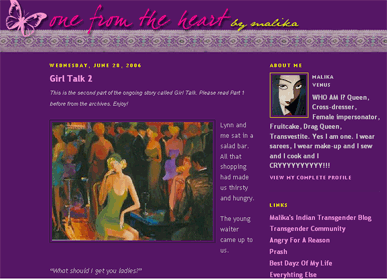
I have opened a new blog which is called 'One from the heart' which will be more of a personal blog, with features like Girl Talk! (Part 2 is posted), and my own articles will be published. Thus Malika's Transgender Blog will be a more of a news and information blog .
Please leave your comments as they give me a possibility to understand what you like or dislike about my posts.
Enjoy!

malika
miss_malika(at)yahoo.com

28 June 2006

Transgender MP fights toilet 'apartheid'

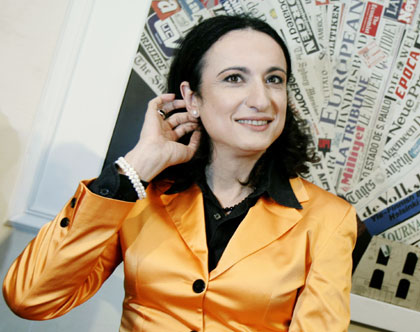
Italian transgender MP Vladimir Luxuria gestures during a news conference at the Foreign Press Association in Rome in this February 22, 2006 before her election.

ROME - Among the most pressing orders of business for Europe's first "transgender" lawmaker may be fighting over which toilet to use in the Italian parliament.

Italian transgender election candidate Vladimir Luxuria gestures during a news conference at the Foreign Press Association in Rome February 22, 2006. The 40-year-old from Italy's main communist party is a candidate in the country's general election in April.


Elected last month, Vladimir Luxuria said on Thursday she was opposed to toilet "apartheid" after a centre-right lawmaker suggested the creation of a special, third lavatory for all transgender politicians.

In Italy, and all of Europe, that means just Luxuria.

"I didn't expect politics to sink this low," Luxuria, a 40-year-old drag queen and defender of gay rights said in an interview with the online edition of Corriere della Sera daily.

Born Wladimiro Guadagno, Luxuria prefers to be referred to as a she and expressed a general preference for women's bathrooms. She suggested women reacted better than men did.

"There are many difficult moments in the life of a transgender and even some embarrassing ones, like the use of public bathrooms. Maybe we go to the ladies' toilet because the men get embarrassed," Luxuria said.

Italy's first transgender lawmaker Vladimir Luxuria, who entered parliament under the Communist Refoundation party's banner, waits for the results of the vote for Italian lower house speaker Fausto Bertinotti at the Montecitorio Palace in Rome April 29, 2006.

The transgender toilet, Corriere said, was suggested by a newly elected lawmaker in the lower house of parliament, Lucio Barani, a member of centre-right opposition.

Barani said in a statement it would avoid embarrassment.

Luxuria, who has dressed in low-key women's suits since entering the world of politics, is keen not to be considered a novelty along the lines of porn star Ilona 'Cicciolina' Staller who sat in the assembly in the 1980s and was famous for her impromptu stripteases.

Among her campaign issues was a promise to seek legal recognition of civil unions by homosexual couples.

"The apartheid of urinary segregation is not an issue that moves me particularly," Luxuria said. "I don't want the privilege of having a toilet all to myself."

It is not the first time that Luxuria has found herself under attack by the centre right.

Alessandra Mussolini, granddaughter of Italy's wartime fascist dictator Benito Mussolini, attacked her on state television when she was asked by Luxuria whether she wanted to lock up homosexuals.

"Meglio Fascista che frocio ! " Better a fascist than a faggot," Mussolini snapped.

See the Video clip of the above discussion in Italian:
duration: 1:06

20 June 2006

Begum Nawazish Ali - Pakistani Transvestite Tv Hostess


Ali Salim's Alter Ego
Dressed to shock, the Begum has it her way
Begum (Mrs.) Nawazish AliBorn a boy, Ali Salim long prayed to God to make him a girl. Years later, he is the most famous female TV identity in this devoutly Muslim, male-dominated country, even though his physiology remains unchanged.

Salim’s chiffon-wearing alter ego, Begum (Mrs.) Nawazish Ali, has become an overnight star, using style and pomp to confront prickly topics with Pakistani politicians, Islamic religious figures and celebrities, posing questions that more established journalists routinely steer clear of.

He is very reminiscent of Dame Edna, Australian Barry Humphries’ famous alter ego for the stage and TV, but Salim says that his character was not inspired by the more slapstick Australian. “I have heard about Dame Edna and have also gone to his (Humphries’) Web site, but I am not motivated by his show,” he said. “I do it in my style and he does it in his.” However like Dame Edna, Salim’s teasing and sarcasm has allowed him to tackle head-on the discrimination women face in Pakistan’s male-dominated society. “My show is about empowering women psychologically,” Salim told the Associated Press on the set of his popular show filmed in Karachi. “I am trying to show people that there is no difference between men and women. I have no gender bias. Men and women are equally capable of doing all the same things, except for their reproductive roles.”

Since it first aired eight months ago, ‘The Begum Nawazish Ali Show’ has built up a massive following, particularly among younger Pakistanis such as college graduate Saima Kareem, 23, who says that Salim “Is asking hard questions of people who otherwise remain untouched by TV shows.”

Begum (Mrs.) Nawazish AliWhile very popular, Salim’s show has ruffled some feathers in a country where Islamic customs generally frown upon cross-dressing. “We decided to create a larger-than-life character to host a talk show where the host would be flirtatious and look good allowing her a strong footing with her guests,” Salim explained. “She can intimidate her guests and break through their tough exteriors to reach the inner person that he or she is.” On the set of a recent show, film producer Rashid Khawaja pondered whether his host could be cast as a heroine for a future movie. Deeply immersed in his character as Mrs Nawazish, Salim curled his lip and suggestively replied: “Well, I don’t want a small one, I want a BIG one,” before clarifying the remark with, “I don’t mean that kind of role, I mean a role in the film.” Naimatullah Khan, a former Karachi mayor and Islamic political leader said that he did not even know Salim was a man when he went on the show. “Although I had the chance to say what I had in mind, I do have reservations on the way he conducts himself and talks,” Khan said. “I don’t think it is good to perform like this. It is not acceptable in our society.”

Dressed in character (a sleeveless, low-necked, blood-red chiffon gown) for an interview with The Associated Press, Salim said that he grew up surrounded by women; his divorced mother and her friends. “Ever since I was a child I used to fantasize about growing as a woman,” he said. His role models included former prime ministers such as Pakistan’s Benazir Bhutto, Margaret Thatcher of Britain, “and all other famous women of that time”.

Begum (Mrs.) Nawazish AliSalim said that his character helped put a modern face on a nation of 150 million people, which usually captures global attention through coups, earthquakes and war. “Begum Nawazish Ali represents the aspiration of all the Pakistanis who want a modern, progressive Pakistan,” Salim said. “She is the face of an enlightened, moderate Pakistan.” Salim said he plans one day to marry but only once he finds a partner of equal intellectual capacity. “I am a man performing as a woman,” he explained. “I don’t have a boyfriend or a girlfriend either.” Khalid Farshori, a senior media commentator in the weekly magazine Akhbar-e-Jahan, said that Salim’s show was groundbreaking and that it would encourage other channels to “come out with brilliant ideas to amuse viewers, who were fed up with the monotonous shows that we have here.”

Salim said he gets nothing but praise from his viewers, even after they realize he’s not really a woman. “Not a single piece hate mail or a threatening call,” he said. “Now people greet me on streets and show me love and respect.”

See an Episode (in Hindi) 30 mins in all

Part 1

Part 2

Part 3

12 June 2006

Transwoman Behind the Matrix Movies

"Matrix" and "Matrix Reloaded"
Director Larry "Lana" Wachowski
Following all the stories about ''Matrix'' co-creator Larry Wachowski allegedly taking hormones to prep for an upcoming sex change operation come reports from sources that say distributor Warner Bros. may be doing an alteration that will take a lot less work. For the third ''Matrix'' film , it seems the writing and directing credits for Chicago native Larry and his brother and partner, Andy Wachowski, will merely be listed as ''The Wachowskis.''

''That certainly would solve any gender issues that might be pending,'' a "Matrix" insider said Monday.

An in-depth story in the current National Enquirer goes into all the gory details of Wachowski's split from his wife, Thea, the onset of an S&M relationship with a dominatrix (who reportedly calls him ''Lana''), his penchant for wearing women's clothes and lingerie and his recent appearance at the Cannes Film Festival--wearing earrings, full makeup, etc.

Neither Warner Bros. nor a rep for the Wachowskis would comment on any aspect of this story.

pic: Lana with a journalist and Lana with brother Andy at the Matrix DVD release.

06 June 2006

India's eunuchs seek new way

By Sanghamitra Chakraborty in Tamil Nadu

Sudha is dusky and wears a salwar kameez, a traditional dress for women in India, but no make-up.

She is a eunuch (or "aruvani" as they now prefer to be called) and represents a group of transsexuals seeking respect for their identity and greater acceptance in society.

"While transgender people must protect their identity, we are willing to do our bit to gain acceptance," says Sudha on the sidelines of a community festival in southern Tamil Nadu state.

"If necessary we will dress down, tone down our speech, even desist from the commonly misunderstood practice of 'clapping' and negotiate with people in work and social settings."

Since most hijras end up being stereotyped as cross-dressing men, feared for their lewdness and aggression, the aruvanis face many day-to-day challenges, linked with their identity.

New tactics

For most hijras, as Indian transsexuals are called, their physical appearance is an extension of their transgender identity.

Lavish doses of make-up, flowing wigs, harsh, staccato clapping and aggressively sexual speech and body language are tokens of belonging, entrenched at an early age by community leaders.

Sudha(right) and Aruna(left in the picture) her friends want hijras to change tactics to win acceptance.

Eunuch groups now participate in community-led inter-personal communication sessions regularly in what they see as a pragmatic way to learn how to negotiate with the mainstream.

"We are focusing on the aruvani being a woman in day-to-day life, not just in front of the mirror at home," says Sudha.

Bharathi Kannamma, a journalist, says the communication sessions seem to be addressing the problem.

"Earlier, when aruvanis were teased or harassed, they fought back often by shouting and using foul abuse. This created a bad impression in the minds of the general community," she says.

Spreading awareness

A trainer, Rajakumari, says eunuchs are much more in control of their lives after attending the sessions.


We aruvanis have achieved in the past two years what was left undone in the past 20 years. Wait and see what young aruvanis can do
Aruna, transsexual

"When people mock or tease them, they don't take off in a rage as they understand that the public can be ignorant or insensitive," she says.

There is more on the minds of the aruvanis than celebrating their yearly festival in the village of Koovagam in Tamil Nadu.

"We're fighting for our right to live and work with dignity as other women do. The violence against transgender people must stop," says Sudha's friend Aruna, who marched along with 500 other transgender protesters.

"They lead many self-help groups working in Tamil Nadu, spreading awareness about safe sex and HIV to hundreds of transsexuals, many of whom are sex workers or beggars."

Delhi-based historian activist Mario D' Penha says there is a "huge debate" raging in the eunuch community "about the right path to integration and whether they should be seen as eunuchs or women".

Not recognised as females by law, these castrated males face a very real identity crisis. Once their surgery has taken place they are no longer considered male and there is no legal framework in place to deal with them.

One of the most important aspects of the training is to impress upon the community the need for safe sex.

Since many of them are extremely vulnerable to HIV, given their social isolation and low literacy levels, short films, documentaries and modern parables are used to improve social skills and to highlight health issues, such as the need to use condoms.

"From living on the fringes of society, they are not only working towards 'mainstreaming' themselves, but are now focusing on expression of their hidden talents that can contribute to them being accepted as citizens in their own rights," says Dr R Lakshmi Bai, chief of a local HIV prevention project.

Aruna is hopeful about the future.

"This is the way to go. We aruvanis have achieved in the past two years what was left undone in the past 20 years. Wait and see what young aruvanis can do."

Story from BBC NEWS:


Published: 2006/06/05 14:54:00 GMT

30 May 2006

Koovagam Festival - Transgender Festival

Get married in the night and break the 'thali' the next morning. This is the essence of the Koothandavar festival
celebrated by the eunuchs.

pic:
'Miss Koovagam' beauty contest Winner - Ranjitha (center) 1'st runner up - Mudumitha 2nd runner up - Rosie.

The village of Koovagam is next to Ulundurpet taluk in Villupuram district. The Koothandavar temple is situated in this village. This is the only temple for eunuchs, and their family deity is the Koothandavar.

A fifteen day Chitrai festival based on Mahabaratha is celebrated every year in grand style. According to the Mahabaratha, Rajakumaran, a eunuch was born to Arjuna and Naga Kannigai. The Pandavas, decided to sacrifice a human to ensure victory in the war and Rajakumaran was the sacrificial 'goat'. His last wish was to get married.

No one came forward to marry Rajakumaran. Lord Krishna appeared as a female and married him. The next day he was killed. To signify this, the marriage is held the previous night and breaking of the 'thali' the next morning is done every year as a ritual.

Check the link below for a interesting photo blog on Coovagam by RYAN LOBO

05 May 2006

Transsexuality in Iran

Before the Islamic Revolution in 1979, the issue of transsexuality in Iran had never been officially addressed by the government. Beginning in the mid-1980s, however, transgendered individuals have been officially recognized by the government and allowed to undergo gender reassignment surgery.

pic: Athena, a 20-year-old male to female transsexual in conservative Iran, brings tea to her father and her sister at her home in Tehran.


History

Pre-1979

In 1963, Ayatollah Ruhollah Khomeini wrote a book in which he stated that there is no religious restriction on corrective surgery. However, this applied only to intersexuals, and at the time Khomeini was a radical, anti-Shah revolutionary and his fatwas did not carry any weight with the Imperial government, which did not have any specific policies regarding transgendered individuals.[1]

After the Revolution

The new religious government that came to be established after the 1979 Revolution classed transsexuals and transvestites with gays and lesbians, who were condemned by Islam and faced the punishment of lashing and death under Iran's penal code.

One early campaigner for transsexual rights is Maryam Hatoon Molkara, who was formerly a man known as Fereydoon. Before the revolution, she had longed to become a woman but could not afford surgery. Furthermore, she wanted religious authorization. Since 1975, she had been writing letters to Ayatollah Khomeini, who was to become the leader of the revolution and was in exile. After the revolution, she was fired, forcedly injected with male hormone, and institutionalized. She was later released with help from her connection, and she kept lobbying many other leaders. Later she went to see Khomeini, who had returned to Iran. At first she was stopped and beaten by his guards, but eventually Khomeini gave her a letter to authorize her gender reassignment operation. The letter is later known as the fatwa that authorizes such operations in Iran.[2]

A small number of Iranian clerics have advised that homosexual men and women undergo gender reassignment in order for them to be able to live normal lives.

Contemporary status

Khomeini's original fatwa has since been reconfirmed by the current Supreme Leader of Iran, Ayatollah Ali Khamenei, and is also supported by many other Iranian clerics. [3]

pic: Maryam Hatoon Molkara, who was formerly a man known as Fereydoon, was an early campaigner for the rights of transsexuals in Iran.


However, there is still a great deal of stigma attached to the idea of transsexuality and gender reassignment in ordinary Iranian society, and most transsexuals, after completing their transition, are advised to maintain discretion about their past. Once a transgendered individual has undergone gender reassignment, that person legally becomes the proper gender - male, in the case of transgendered men, and female, in the case of transgendered women. All legal documents, such as birth certificates and passports, are also changed accordingly.

Hojatoleslam Kariminia, a mid-level cleric who is in favor of transgendered rights, has stated that he wishes "to suggest that the right of transsexuals to change their gender is a human right" and that he is attempting to "introduce transsexuals to the people through my work and in fact remove the stigma or the insults that sometimes attach to these people." [4]

UNHCR's 2001 report says that sex reassignment surgery is performed frequently and openly in Iran, and that homosexual and crossdressing people would be safe as long as they keep a low profile.[5] However, Safara Project's 2004 report considers UNHCR's report over-optimistic. Safara's report suggests that UNHCR underestimated legal pressure over LGBT.

The report further states that currently, it is not possible for transgendered individuals to choose not to undergo surgery - if they are approved for gender reassignment, they are expected to undergo treatment immediately. Those who wish to remain "non-operative" (as well as those who crossdress and/or identify as genderqueer) are considered their biological gender, and as such they are likely to face harassment as being homosexuals and subject to the same laws barring homosexual acts. [6]

References

External links

Source: Wikipedia

Watch the trailer of a documentary on Transexuality in Iran:

16 April 2006

PAKISTAN: Hijras caught in no man's land between two genders

12 Apr 2006 11:32:05 GMT
Source: IRIN
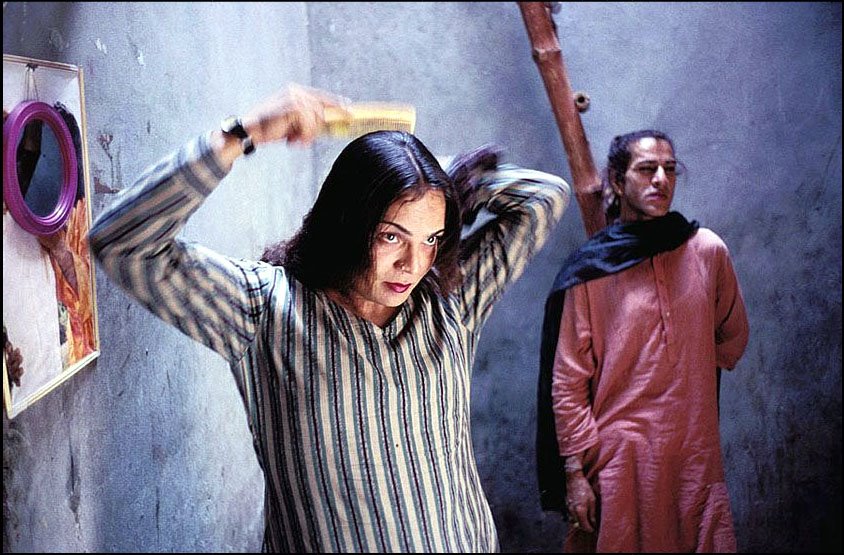
LAHORE, 12 April (IRIN) - Looking carefully at her reflection in a shop window, Azra combs out her dark, somewhat stringy hair. She then coyly flicks the lock back over her shoulder, adjusts her red 'duppatta' (scarf), and approaches two women shopping in Pakistan's western city of Lahore. In response to her high-pitched pleas, and saucy comments about their looks, the women hand over a few coins – and Azra sways away, her hips swinging as she moves down the pavement. Azra was born as Azam, in a village close to the city. Her parents, who already had two daughters, were delighted over the birth of their first son and distributed sweets through the village to mark the occasion. But, Azra says, talking to IRIN, "Almost from the start, I knew I was different. I felt like wearing the shiny dresses my sisters wore, and playing with their dolls – but I was beaten by my father each time he caught me draping a bright duppatta around my head, or trying on my sisters' shoes." When he was 15 years old, Azam ran away and his parents seemed relieved to see him go, as did his two younger brothers, both 'real boys', according to Azam. Azam was spotted on the streets of Lahore by other hijras (transvestites or hermaphrodites), and taken home by them to their house in the city's Mozang area, where six 'daughters' lived under the guidance of their 'mistress', an elderly hijra who presides over the unusual household with an iron hand. The hijras, or transgender people as they are sometimes known, occupy an unusual position within South Asian society. They have long been an entrenched part of the culture in Pakistan and India, with the first references to their existence appearing in ancient Hindu texts dating back to 1000 BC. But then, as is the case now, the hijras are considered social outcasts, existing in a strange, no man's land. They are however reluctantly accepted – even though they are often an object of laughter, scorn or even fear. Tahir Khilji, Director of Vision Pakistan, a social organization that aims to educate male sexual workers - including transvestites - about AIDS and other sexually transmitted diseases and to rehabilitate sex workers, has been working with the hijra community for several years. His is the first organisation to take up the issue of male sex workers, using HIV/AIDS as the route to approach it. Khilji and his sister, Naheed Khilji, have described the hijras as "innocent people", who have been rejected by society and are extremely vulnerable to exploitation. They point out that even the hijras' families refuse to accept them. Many myths exist about the hijras in local tradition. "It was because of a hijra's prayers that I was blessed with children. I remained childless for eight years after my marriage because another hijra had placed a curse on me," Habiba Bibi, 40, told IRIN. Many ordinary people believe the hijras have mysterious powers to curse, or bless people, and that it is important not to anger a hijra to avoid her curse. This is one of the reasons hijras are traditionally invited in to sing and perform at occasions such as weddings or the birth of a male child. While in some cases they gather outside homes where such ceremonies are being held, aware that they will be called in and showered with cash and gifts to avoid bad luck, in other cases they are invited to perform by those hosting ceremonies. The hijras, at least 10,000 of whom operate in Lahore, are clustered in various parts of the city. One point is Heera Mandi (Diamond Market), the red light area of the city, where they have lived for centuries. Some still based there claim they have descended from the eunuchs who served as servants in the courts of the Mughul rulers of India, several hundred years ago. Others live in Samnabad, Mozang and other areas scattered through the city, almost always setting up house under an elder 'guru', or mistress, who is in charge. They are divided into castes and sub-castes, and live under their own set of cultural rules. Many hijras pray regularly, but do not attend mosques, taking on the role of women in this regard. In some cases, they are taken by men as long-time lovers, or mistresses. Many hang around shrines, as they have done for centuries. "Most of us know very early in life that we are different. We ourselves choose this life. The stories that baby boys are stolen away by hijras and castrated are false," maintains Ghazal. Ghazal (not her real name), was born as Ahmed to a relatively well off family in Wazirabad, a small town some 200 km from Lahore. "My parents sent me to psychologists, doctors, everything, in the hope I could be cured. Now I am just relieved I can be myself," she said. While most transgender people in the city are transvestites, or "people who have women's souls inside men's bodies" as the hijras themselves say, others have undergone crude sex change operations. This essentially means castration – an operation secretly performed by gurus. Hijras seeking the surgery visit homes where it is performed, and the patient is then kept heavily dosed with painkillers and sedatives for days afterwards. Some die as a result of the procedure. Others take female hormones to encourage breast development, a change in voice and reduce body hair. Many don't bother – but almost all spend a considerable amount of time on their elaborate make-up, jewellery and attire – which makes them look like colourful, gaudy butterflies as they flit through bazaars, collecting 'gifts' from shoppers or traders. The loud, rude comments made by the hijras about those who give nothing often act as an incentive to hand over a few notes, with the turfs along which groups of hijras operate strictly delineated according to the code by which the community known as the 'third sex' lead their hidden lives. Apart from this, they earn money by singing at special occasions, such as weddings, and through prostitution. Male prostitution, not only among hijras but also other categories of male sex workers, is common in Lahore and other cities, despite the religious taboos that exist. Like their female counterparts, the male sex workers suffer acute exploitation, and indeed some argue that their situation is even worse than that of female sex workers because of the ignorance that exists about the dangers of HIV infection and the fact that all such sex is deemed a criminal act under Pakistan's Islamic laws. Locked in their own, largely hidden world, the hijras continue in the midst of a society that does not understand them, and indeed barely tolerates them. This has, for them, been the norm for centuries – and remains their way of life in a modern world where they have created a precarious niche for themselves.
Pics: http://www.brunomorandi.com/

07 April 2006

Girl Talk - part 1

It has been a long time since I met my ex-wife. My cross-dressing had finally killed our marriage. After years of trying to understand and explain why I liked to dress up as a woman she had decided to leave. I had been a painful separation but she was right I guess.

“I want to be with a man” she said “not with a woman”.

I don't know if that had hurt me or had I felt an empathy for her. I understand what she felt.

But that was a long time ago.

“Hi! How are you?”

“Fine” I said, a little surprised hearing her voice.

“And you?”

“Fine, fine! It's been a long time... Shall we meet?”

I thought for a while, was I ready to meet her?

“Sure” I said without thinking.

“Do you want to go shopping with me, tomorrow?

There’s a sale on at Mango, we could get some lunch after that”

I want to know all about you"

I agreed.

I was scared.

I had a lot of mixed feelings.

Did I want to do this?

Should I go dressed as Malika or should I just go in ‘the drab’?

I didn’t sleep very well that night but the next morning I woke up feeling nice. I had to go through this.

I had a shower and went to the salon. I got my hair blow dried, I got my nails painted.

The girls in the salon were always very nice. Some of the clients smiled, said hello, some looked away or looked shocked. The salon girls always made me feel at home. I told Sheila that I was going to meet my ex. She smiled and held my hand and pressed it tight. She said nothing but I felt that she had transferred her strenght to me. This is something I had never felt with my male friends... this was how women were with each other, a sort of silent sorority, a humaness so absent in the male world.

I came back to my flat and looked at my wardrobe. I tried many of my outfits. Skirt? Dress? Jeans? Dressy? Casual?

It had to be right.

I finally choose a flared beige flowery chiffon skirt, , brown sleeve-less top, my knee high boots. I did my make-up, light and simple. Just a little blush-on, some black eyeliner and caramel lipstick.

Little dangling earings with garnets, a thin chain with a garnet pendant.

I looked at myself in mirror. I liked what I saw. I put on my coat, tied a silk scarf round my neck and picked up my brown leather purse. I slung it up over my shoulder.

Dabbed Kenzo flower, behind my ears, on my wrists, a little here and there.

My heart skipped a beat… I wanted to call her up and say that I had changed my mind…

Then things moved fast... the bus... the walk...

I waited for her outside the shop… There was a huge crowd of women. Some of them looked at me, some smiled nicely, knowingly, others giggled. I always wondered what went on in their minds when they saw me.

Then I saw her coming. She had a huge smile on her face.

“ Hello, Madam!” she said.

We hugged. Then she moved away to look at me.

It seemed like eternity.

She smiled "Wow! You look very cute".

She took my hand in hers and led me inside the shop

"Come on, girl ! Lets have fun" She winked


to be continued...

Part 2(new) & 1 available on my new blog One from the heart

painting "F e m m e d é c o r é e"

Oil on Stretched Canvas 33 X 61 CM 12.9 X 23.8"

by Vladimir Bourrec

31 March 2006

Paris Protests Against Nepal's Crown Prince Over 'Sexual Cleansing Drive' Against Transsexuals

March 27, 2006 - 9:00 pm ET (Paris)
Human rights protestors demonstrated against the visit to Paris by Nepal's Crown Prince demanding an end to what they called a "sexual cleansing drive" aimed at transsexuals.
Carrying black flags, gay rights and AIDS activists joined other human rights protestors and exiled Nepalese demonstrated at the Eiffel Tower.
Crown Prince Paras is reportedly on a private visit to Paris.
The protests come a week after Human Rights Watch reported that transsexuals and HIV/AIDS outreach workers in Nepal's capital Kathmandu are under increased scrutiny by police.
Human Rights Watch first raised the alarm in January after groups of transgendered women, called Metis in two separate incidents were attacked by police and the military.
Human Rights Watch says the situation has gotten increasingly worse. Earlier this month police rounded up 26 metis. According to the Blue Diamond Society, a Nepali organization working in the fields of sexual rights, sexual health and HIV prevention, they were taken to the Hanuman Dhoka central police station in Kathmandu.
Five were later moved to Kalimati police station. Human Rights Watch understands that as of March 16, they have still not been permitted to speak to a lawyer. All have reportedly been charged with committing a "public nuisance."
"This is the latest incident in a violent police campaign to 'cleanse' Kathmandu of those considered undesirable," said Scott Long, director of the Lesbian, Gay, Bisexual, and Transgender Rights Program at Human Rights Watch. "Police regularly assault and in some cases sexually abuse transgender people, all in the name of enforcing 'moral values.'"
Those arrested included two staff, two outreach workers, and two peer educators working for the Blue Diamond Society.

Photo: A Nepali Sister

29 March 2006

Pic of the Day


Elizabeth Jeffords (TG Voices) with transgendered persons in Chennai.

Read article : Outsourcing, Tailored for Eunuchs

24 March 2006

Dance like a woman - Narthaki Nataraj

A rechristening happened after the debut performance. Nataraj became Narthaki. Hailing from Madurai, Narthaki had her formal training in Bharatanatyam under the legendary guru K P Kittappa Pillai who has trained some of the great exponents like Vyjayanthimala, Hema Malini and Yamini Krishnamurthy. From 1985 till his demise in 1999, Narthaki was trained in the rare compositions of her guru and of the Thanjavur Quartet apart from popular compositions. She has the rare distinction of having worked along with her guru in the Music Dept of the Thanjavur University as his assistant.

Narthaki, though not a natural born woman, specializes in depicting bhava laden nayaki roles and a lot of research goes into her productions. Narthaki established her dance school Narthaki Nrutya Kalalaya in Madurai in 1989 and recently in Chennai. More than 100 students including overseas students are being trained in her schools. Artistes who face the same identity crisis as her are treated kindly and welcomed.

I hope I have done justice in my English translation of what she expressed in beautiful Madurai Tamil.

(‘We’ in the interview refers to Narthaki and her childhood friend Shakti who shares the same gender problems).

When did you first realize you were different?
From the time I knew what life was, the only things I experienced were taunts and rebukes. I was about 7 then and did not know how to express myself the way I do now with courage and conviction. I could not understand in what way I was different from the other boys, only that I felt more safe and at home with girls. I knew I would be thrashed if I expressed my thoughts and remained silent.

We have come up the hard way, faced so much scorn and censure and lived in fear. People born like us generally take the easy way out and go into the oldest profession in the world. But we did not let the shame and rejection break our spirits. Our grit and determination to carve a name for ourselves as respected artistes has brought us where we are today. I have spent many a moment shedding tears in my house terrace or by a lonely pond, ruminating on why I was born like this, but the desire to overcome these hurdles and shine was uppermost in my mind.

We did not want to be like something on show. Maybe like some tidbit in Dina Thanthi that says, “He suddenly became a woman” or, “ Sita has become Ramu”. My case is nothing like that. If you could look into my heart, you will see the agony and scars. I am in no way inferior to a woman when I do my nayaki roles. Not every natural born woman is a successful dancer or leads a trouble free life. In no way have I spoilt my life by living life on my terms.

When did your interest in dance start?
As far back as I can remember I was always interested in dance, wanted to dance to an appreciative audience and excel in my art. I used to get opportunities to do 3 to 5 minute dances for functions and small events. I did not know formal dance as such, my imagination helped shape my movements. So, unknown to my family, I used to give performances and wipe all traces of makeup for fear of punishment before coming home, but they always managed to find out.

Since you had no formal training at that young age, who / what was your inspiration?
I used to see films, especially films that had dance in it. Vyjayanthimala in “Parthiban Kanavu’ was so inspiring, Padmini’s dances were classy, Kamala’s style was different. I used to imagine I was Padmini or Vyjayanthi. We would see the late show in Madurai Anapanadi and on the way back home, at 2am on the deserted Thennamara Road, I used to do my interpretations to my one-member audience, Shakti. Dogs belonging to the gypsy settlements by the roadside would chase me sometimes; I’ve even been bitten! How would they know I was dancing!! I could hardly tell my family and tended to my wounds myself.

The aftermath of the film dances used to be with me for a week and it irked my family to see me making eyes in the mirror! I would be spanked and the misery made me resolve many a time to try to be like any other student, study and go for a job. That would last only till the next offer to dance maybe in a temple and I would get back to it with renewed energy! My makeup stuff would be hidden in various secret places, so I would start gathering them in readiness, organize for a wig and so on. I used to get lots of prizes but gave them away as I could not bring them home.

Who was your first teacher?
Seeing my dance, many advised me to get a good teacher and learn dance the proper way. An elderly relative, who visited my house frequently and recognized my talent, could not bear to see me treated harshly and took responsibility to get me a good teacher. Unfortunately, for him dance and drama were same and he took me to a stage actress who used to act in all night plays and sleep through the day! I finally had to plead that I wanted to learn dance and not acting! She was kind enough to single out a teacher Namanur Jeyaraman from the Thanjavur bani to teach me, but we had to travel to Sivaganga to meet him. The meager funds provided by Shakti enabled only me to accompany the actress to Sivaganga. Shakti and I had started dance together but now, for the first time, Shakti’s ambitions took second place and she sacrificed everything for me from then on.

How old were you then?
About 12. I was thrilled to enter the hallowed halls of guru Jeyaraman’s house, and saw the photos of Kamalahasan’s sisters who had learnt from him. But the teacher was extremely ill and bed ridden and my heart sank. He asked me to pray to Goddess Meenakshi that he would recover enough to teach me when he came to Madurai for medical checkups.

Surprisingly, I got a card from him a month later to get a space ready for classes. But where? There was a school nearby which used to open very early for the Trustees’ children to play in and we used the opportunity till we were found out! After that it was in homes of known people who could not tolerate ‘the noise’ after a couple of classes. Finally, a good soul in a slum 8 km away offered his hut for my classes. That was a good 90 minutes walk from my house.

When was this?
Around 1982. My guru was skeptical when he saw the place, but he obliged on seeing our eagerness to learn. Shakti had left school after 9th class and the money she used to get from working in her family textile business went towards paying my guru for my dance classes which cost Rs.80 a month and Rs.20 for his conveyance. That was a lot of money for us at that time. I used to pretend I was going to the temple at 5am, Shakti used to come from her house and we used to rush all the way across town to class and despite walking for 90 minutes, I danced so vigorously that my guru used to get tired just watching me! On the way back, we used to bring vibuti and kumkum to substantiate our claim but our families had their suspicions all the same!!

In the course of a year, I learnt a full margam and got ready for my arangetram in 1983. I presented ‘Mohamana’ in bairavi, a saveri Jathiswaram, husseini Padam, kanada Thillana in rupaka tala. ‘Mohamana’ is my favorite piece and I think I dance it quite nicely because I see people enchanted with my performance.

How did your arangetram go?
I actually had the audacity to personally go to the Madurai Mayor’s house and invite him to be chief guest. No one believed he actually would, even my family whom I finally informed, but the Mayor did keep his word and it was a great event at the Thamuka Maidan in Madurai where many important functions take place. Shakti and I had to cycle across town to collect the wig and we returned just in time for me to make up and start. From then till now, we do our own makeup. It rained heavily but I felt the heavens were blessing me. I was the talk of Madurai that evening.

What about the orchestra?
My guru had his own group. He sang and did the nattuvangam. He used to sing beautifully. Venu on the flute, Thyagarajan on the mridangam were all experienced vidwans who accompanied stalwarts like Sikkil Ramaswamy. My guru died a month later. It was as if God had kept him alive for a year just to teach me and conduct my arangetram. I started giving many performances after that.

How did you become Kittappa Pillai’s student?
Being a fan of Vyjayanthimala, I wanted to learn under her guru too. Kittappa Pillai had just received the Isai Perarignar Award and I knew from magazines that he was then at Thanjavur after returning from his travels abroad. So, we rushed off to Thanjavur to become his students, which was easier said than done. To become his student is nothing short of a miracle. He said he had heard about me but he had a hectic travel schedule in India and abroad. He would ask us to attend Vyjayanthimala’s performance in Bangalore or Sudharani’s performance in Chennai and on seeing us there, he would wonder why we were there! It was hard on us financially, but we persisted relentlessly for nearly a year and like a miracle, he one day announced, “Come tomorrow. We will start class”. We rushed back to Madurai and returned the following day with the flowers and fruits for guru dakshina.

It is the most unforgettable moment in my life. When I started my adavu classes under the great guru Kittappa Pillai in the fabulous hall of the Ponniah Natya School for the first time, I was brimming with happiness. It was like heaven. The more I danced, the more I felt I was nearing the treasure at a rainbow’s end. In a year, I learnt a full margam. He usually did not teach rare compositions to everybody on completing a margam, but he made an exception in my case. I felt so honored. However hungry I was, I danced on. His wife, such a kind lady, could always tell from my face and used to have food ready for me when class was over. She passed away barely 2 years after master did.

Where did you stay when you were his student?
I stayed at his house. He has a beautiful hall upstairs.

What kind of a guru was he?
I was always treated as a member of his family. He was so understanding and approachable, that one could go to him for advice on anything from dance to personal problems. After class, he would lay down his big bulk on the bench. I would sit beside him and ask his advice on dance, my fears, my gender problems, if I should continue dance. He always gave me affection and encouragement to pursue my goals. He had confidence in me that I would shine one day.

I have performed in this very same Mylapore Fine Arts in 1987 with Kittappa Pillai doing the nattuvangam. It was for Cosmos Club. He was foremost a great musician and mridanga vidwan, and only then a dance guru. When he got carried away with a student’s dance, he would burst into song himself and sing the raga in an innovative way that was all his own. Nobody could handle Shankarabaranam or Khamas the way he did and the vocalist unable to match his skills would keep quiet and let him sing. The bhavam he gave the ragas was like the gentle drizzle, like the soft wind blowing. His sangatis were out of this world; I have them on my tapes. Once during my performance, he just turned and said ‘Shabash’ (Well done) and that is still in one of my cassettes and I treasure it. I have many cassettes with compositions sung by him.

I think it’s my poorva janma punya (blessings of a past life) that I am blessed to have been his student in spite of the way I was born. To learn from him was a divine experience, I considered him a siddha purusha. Even in his 80’s, his memory power was so amazing; he had better memory than a computer. If I forgot a korvai, he would correct it to perfection. He remembered the smallest movement of an item done many years ago in such minute, exact detail. He was an amazing person. Even 4 days before he died, my guru clarified some doubts I had about a theermanam, which I was to perform in the Dussera Festival.

My guru was very interested in my welfare. He knew his end was nearing and gave me a testimonial in 1995 to help me in my career and that is my most prized possession. He was very appreciative of the nayaki roles I did and advised me to write a research paper on ‘nayaki bhavam’. He gave me lots of tips on that.

Can you elaborate on the ‘nayaki bhava’?
Many males do female roles in a beautiful manner, like Shivaji Ganesan did. Sometimes, the makeup man gets the credit. But I think there’s a difference in the way I do the female roles.
Whenever I start a project or have to interpret a song, I delve deep into the inner meanings, the emotions behind the words, the situation, so I can give the correct bhava interpretations. So, I do a lot of research, read a lot, dissect the pada artha and arrive at the final presentation. Artha should not become anartha!! So, along the way, I have collected some very rare books and scripts and these are my prized possessions, my little library.

What are some outstanding / cherished moments in your career?
It was a wonderful experience that my guru and I worked together as teachers in the Thanjavur University in the Music Dept between 1990 and 1994. I worked as his assistant. After a lapse of 20 years during which no performance had taken place in the Madurai Meenakshi temple, Shakti and I performed there to a massive gathering this year on January 16th.

Are you proficient in music too?
I have a basic knowledge of music. I am going to concentrate more now on learning music. I want to learn better English too, so I can express myself better!

How different is it to perform to a rural audience?
People who come for Sabha programs have a basic knowledge unlike the rural audience and that’s where the challenge lies. I always perform in the remote towns with trepidation and the greatest compliment is when someone comes up to me and cites some instance from my presentation and I know I’ve been understood. I am proud to say I’m a regular performer at these villages and towns.

What response did you get when you opened your dance school in Madurai?
I established Narthaki Nrutya Kalalaya in 1989 in Madurai. I had no problems in getting students, because it was well known that I was guru Kittappa Pillai’s disciple, so students came readily to me to learn. I always perform my guru’s compositions solo. Now I perform duets with Shakti and some group productions with my students.

Shakti has been a great support to you.
Yes, I won’t be what I am today if not for her sacrifices. We started learning together. Due to lack of money (I had none, she had some), she let me reap the benefits. She became Kittappa Pillai’s student much later, but guru passed away before she could finish learning a margam. Now I am teaching Shakti all that I know. Whenever we perform together, she’s Kannan to my Radha, Shiva to my Shakti, nayaka to my nayaki.

How do you see your future?
I feel I have come about half way along my journey, but I still have a long way to go. Shakti and I have made a systematic life for ourselves, a schedule. A time to eat, a time to sleep, a time to rehearse, a time to perform and so on.

Will you teach the rare compositions you know to others or you want to keep it to yourself?
What will I gain by keeping it to myself? I will teach anyone who’s genuinely interested but I must be convinced that this person will retain the purity of the composition. My guru preserved intact what his guru taught him, I want to do the same and I want my student to do likewise.
I have also done some novel interpretations of old themes from the works of Subramania Bharathi and Bharathidasan and some rare and little known pieces centering on heroine oriented themes from Thevaram, Thiruvachakam, Thirupugazh, Divya Prabandham and other religious epics.
I am looking for someone who will dance like me one day, with the same nayaki bhavam. Even after 200 years, I must live on in history as an outstanding dancer.

Link to source website
22 March 2006

XXIII IGLA

The next World Conference of the International Lesbian and Gay Association, better known as ILGA, will be held in Geneva, from March 27 to April 3,2006. It will be organised by a coalition of Swiss LGBT groups.

The Conference will be held at the same time as the United Nations Commission on Human Rights, an international forum which has failed to this day to recognise us and our rights. It will be another opportunity to remind the UN of the imperative necessity to explicitly declare that sexual orientation and the free expression of gender identity are human rights.

Alternatively, you can let us lead you through this short presentation to become more familiar with the role and importance of ILGA's conferences within the Lesbian, Gay, Bisexual and Transgender (LGBT) Movement worldwide.

Check the programme for two preconferences called Transgender Caucas and Transgender Issues

Link: http://www.ilga-world-conference-2006.ch/index.html

Indian eunuch says will “bare it all” in autobiography

19 March 2006 BANGALORE
From sexual abuse by drunken men to taunts from women and beatings from policemen, eunuch Jereena says she will “bare it all” in her autobiography, the first by a transgender The 128-page book titled “Autobiography of a Hijra (eunuch)” and written in Jereena’s mother tongue Malayalam, spoken in the southern Indian state of Kerala, is slated for release by the end of March.“Nobody in India knows how we struggle for a living nor how we feel when people insult us,” said Jereena, dressed in an orange sari and a green blouse and wearing ear rings, glass bangles and a necklace.“I thought I will write a book to tell them about my life’s experiences. “People who read my book will know the pain we undergo every day, every moment of our lives,” Jereena, 46, told AFP in an interview at her “hamam,” or bath house, as the eunuchs’ brothel is referred to.
“I will bare it all in the book.” Jereena, who uses only one name, left Kerala aged 18 for the southern city of Chennai and shortly after moved again, to settle almost 20 years ago in India’s high-tech city of Bangalore.
“When I was in my fourth standard (grade) I came to know I had a liking for men. I had sex with the principal when I was only nine years. My brothers and parents started bothering me with threats when I told them I wanted to become a eunuch,” Jereena said.“I had to stop my education after passing tenth standard. I knew I have to leave my hometown if I want to become a eunuch. I left my village at the age of 18,” said Jereena.
“Soon I realised the life ahead (would not be) easy,” said Jereena, who heads the eunuch community in Bangalore. “I have to engage in prostitution and begging to eke out a living.”
Men, she says, throw eggs and rotten tomatoes at her and other eunuchs when they walk the streets of Bangalore, and women jeer and scream.
Drunken men often beat eunuchs after having sex with them, police beat them for soliciting customers, and customers sometimes refused to pay, Jereena said.
Doctors often refused the treatment, believing “we have HIV/AIDS,” and no one would give them jobs. “All this will feature in my book,” Jereena said.
“I sell myself to keep the pot boiling. There are eunuchs out here who survive as dancers in bars and by going from house to house in search of a new born baby,” Jereena said.
India’s estimated one million eunuchs are regulars at Indian festivities, entering homes uninvited to bless babies and regularly gatecrashing weddings.
Jereena, who was married to a man for six years but divorced under pressure from her in-laws, said she wanted her autobiography to be educational.
“The purpose of the book is to make others understand and accept us. For example do you know that I have an adopted son. He is not a eunuch and he works as a fruit vendor,” said Jereena.
“Do you know that I work with my colleagues to encourage them to use condoms?” Jereena said. “People think we are without a heart. My book is an attempt to change that and every other negative perception they have.”

21 March 2006

Outsourcing, tailored for eunuchs


Calcutta, May 19: A business venture moving from China to India is giving the 3,000-strong eunuch community of Calcutta a chance to be counted. Sustenance through sewing will be their mantra in a somewhat curious case of outsourcing.

Representatives from Transgendered Voices, Inc., a Colorado-based non-profit corporation, are in town to encourage eunuchs to take up sewing and make clothing for not only the “heavily-built transgender Americans”, but “all kinds of special sizes” not available at readymade stores.

Elizabeth Jeffords and Florence Vanmalderen. Picture by Pradip Sanyal

In town since yesterday, Elizabeth Jeffords, executive director of Transgendered Voices, told The Telegraph: “We want the hijras from here and other parts of India to be self-dependent financially. Ninety-five per cent of hijras that I have met in this country are sex workers. They have not explored other options of sustenance. We are trying to assist them through creative and intellectual activities.”

The fact that there is no wearable option today for Americans “who are not of standard size” could open up a busy new world for a community languishing in bylanes.

“Even 50 to 70 years ago, you could have got tailors to make you specially-sized skirts for transgenders and other big and small people,” said Jeffords. “But now, you only get standard sizes off the racks at the malls. So we have been getting junk clothing made from the lowest levels in China and the Philippines. And now, we want to establish business with India, to get quality clothing at the same price, and help the hijras in the process.”

Having already established a base in Bangalore, Transgendered Voices is hopeful of the response from the Calcutta community. “Although it is not a political theme, I don’t feel a communist society like Calcutta should be any different from a capitalist society like Bangalore. I expect a greater support from the West Bengal government to help them be empowered individually.”

During her week-long stay in the city, Jeffords and her business manager Florence Vanmalderen will meet “important people” like police authorities, AIDS Council representatives and the secretary of the state women and child welfare department.

“To provide a platform for this project, we are having a special dinner at the new Salt Lake convention centre, Rotunda, on Saturday,” said Koushik Chatterjee, chief executive worker of The Bodhi, a local organisation helping out Transgendered Voices. “We want the eunuchs to meet Jeffords and feel comfortable about the proposal.”

But will it help wipe out the social stigma? “Once they start working, they will earn the respect they deserve and merge into the social fold,” said Jeffords, looking forward to seeing Shabnam Mausi (a film on India’s first eunuch MLA).

PRATIM D. GUPTA for The TELEGRAPH, Kolkata

14 March 2006

So you want to be a girl?

I grew up in house full of men. My mom was the only women there. She would lament "I wish I had had a girl! So that I wouldn't feel so lonely.Someone who would share my burden" It was true, no one lifted a finger, she would have to do everything at home.
"Mom, where's my shirt? Mom where's my breakfast? Mom where's the chai?"
She would say she would have liked to be like a Hindu goddess with a thousand arms. So tht she could do all the thousand things at the same time. I would have liked to help my mom but I would not be allowed.
"Go away from the kitchen, you're a boy"
But so many times, I wanted to tell her, "Mom, I want to help you, please let me" But either I did not have the guts or the understanding as to why I felt like this.
And then one day, when everybody was away and I was alone at home. I dressed up in my mom's silk saree, put kajal in my eyes, put on a bindi, wore her glass bangles, her silver payals. I sat down on the bed and put on the TV, watched the TV serials that I would die to watch, the cookery programs, make-up help, fashion. I read her Woman's era and Femina. I felt like a woman, like somone I would have liked to be. This great day would become my routine for a few years. I would wait for days when the whole family went out and I would feign some imaginery fatigue or stomach ache. Now I was dressing three or four times a week. I became an expert on draping the saree. The gestures that I had studied watching my mother and other women became second nature. My hands automatically pulled the saree edge over my fake breasts, I would use the pullu to cover my shoulders, I would hold up my pleats when I went into the bathroom. I would tuck the pullu around me whn I made tea.
Then one day the inevitable happened. I fell asleep dressed in my finery and woke up to loud laughter. I opened my eyes and before me stood the whole family.
I frooze!
My brothers were laughing but were visibly embrassed, angry, disgusted. My father walked away mumuring something. My mother stood there, a smile on her face. She said " My god! You really know how to wear a saree. "
They all left me there on the bed. I did not know what I should do. Should I run to the bathroom and change or should I be brave.
My mom came back again into the room. She studid me and then sat down next to me.
"Why are you wearing my sarees?"
I thought for a while and then looked up at her and said " I want to be a girl!"
She got up. She said you think being a girl is dressing up in a saree?. I didn't say anything.
"So, you want to be a girl?"
She got up and opened the cupboard and took out a cotten sari and threw it next to me. "You can't wear a silk saree and do housework, my dear". She left the room. I sat there my heart racing, what do I do?
She came back a few minutes later "What are you doing? Change your saree and come into the kitchen, there is work to do".
I took the cue, I quickly took off the expensive silk saree and put on the 'house saree', an orange cotten one. I meekly walked into the kitchen.
My mom looked at me and laughed. Lets see if you can be a girl she said.

She handed me a tray with a teapot and cups. "Take this and serve them their tea!"

This was my mother's idea of womanhood.

I took the tray with shivering hands and went out into the sitting room. They sat there watching TV. They looked up at me, their mouths agape.
"Don't be shocked! 'She' wants to be a girl so she is going to be one, lets see how long 'her' desire lasts."
There was a howling round of laughter and sarcastic jokes.
But my mother was soon to be surprised by my resolve to be a girl.

Paintings by: Shuchi Krishnan

Godhuli & Spring


10 March 2006

Guatemala: Transgender People Face Deadly Attacks

Victims Concerned That Police May Have Been Responsible for These Crimes

(New York, February 21, 2006)— The Guatemalan government must take immediate steps to stop a pattern of deadly attacks and possible police violence against transgender women and gay men, and end impunity for these crimes, Human Rights Watch said today in a letter to Guatemalan President Oscar Berger.

One transgender woman was murdered and another was critically wounded on December 17 when they were gunned down on a street in Guatemala City. Paulina (legal name Juan Pablo Méndez Cartagena) and Sulma (legal name Kevin Robles) were stopped by four men on motorcycles at an intersection in Guatemala City's Zone One, the center of the city.
(Photo: Twenty-one year old Melissa Simpson is a transvestite sex worker in Guatemala City. She is part of OASIS, a project to improve the lives of the sexual minority in Guatemala.)
Eyewitnesses reported that the assailants were wearing police uniforms and riding police motorcycles that identified them as members of the national police. The assailants shot Paulina twice in the head, killing her immediately. They shot Sulma three times, and she is still recuperating from her injuries.
Paulina, a former sex worker, worked for the Organización de Apoyo a una Sexualidad Integral frente al SIDA (OASIS), a nongovernmental organization that works to prevent HIV/AIDS and to protect the rights of lesbian, gay, bisexual and transgender (LGBT) people. Sulma is a volunteer with OASIS and a sex worker.

Since the attack, Sulma and other transgender sex workers have reported being subject to undue police surveillance, causing them to fear for their lives. According to Sulma's report to OASIS, police warned her that, as witness to the attack, her life is in danger. OASIS said that its office and personnel have been under undue police surveillance. According to OASIS, the Office of the Public Prosecutor has made no further investigations into the attack since preliminary investigations in late December.

"These cold–blooded shootings are just the latest tragedy in Guatemala's pattern of deadly violence based on sexual orientation or gender identity," said Jessica Stern, researcher in the Lesbian, Gay, Bisexual and Transgender Rights Program at Human Rights Watch. "The police have not done enough to protect lesbian, gay, bisexual and transgender people, and now there is concern that they may be responsible for someone's murder."

LGBT people in Guatemala regularly face attacks and threats. In 2005, at least 13 transgender women and gay men were murdered in Guatemala. On December 21, two men in an unmarked car with tinted windows robbed two gay male sex workers at gunpoint in Guatemala City.

In the space of a single month, three gay men were murdered in Guatemala City late last year. Luis Sicán was shot to death on November 6 in Guatemala City’s Zone One. Flavio José Morales was shot to death in Zone Three of on October 12. Héctor Osmín García was shot to death by a security guard on October 7 while distributing flyers for a beauty salon. According to OASIS, there have been no prosecutions in any of these cases.

In its letter to Guatemala's president, Human Rights Watch outlined several steps that the government should take to end the violence and intimidation targeting LGBT people in Guatemala.

First, the government must ensure prompt, thorough and impartial investigations of the December 17 shootings — as well as other similar attacks reported over the past year. The authorities must also ensure that those responsible for these crimes are brought to justice.

In addition, the Guatemalan government should end any undue police surveillance of Sulma and other transgender sex workers, of OASIS and other NGOs advocating for the rights of LGBT people in Guatemala.

Human Rights Watch recommended that national police work with representatives of LGBT and sex worker communities to introduce sensitivity training in accordance with human rights principles to end discrimination against LGBT people and sex workers.

"Sulma has good reason to fear that the people who attacked her could strike again,"said Stern. "Guatemalan authorities must take immediate steps to protect LGBT people and hold their assailants accountable."

Human Rights Watch sent letters today detailing these human rights abuses to President Oscar Berger, the Office of the Minister of the Interior, the Office of the Public Prosecutor, the national police, the Solicitor for Human Rights, and the Representative of the Office of the United Nations High Commissioner for Human Rights in Guatemala.

Source: Human Rights Watch